

A Maine annual report is the yearly filing that keeps an entity registered with the Secretary of State, Division of Corporations, UCC and Commissions. It is due on June 1, it carries a fee that varies by entity type, and it is the one recurring obligation that most often decides whether a company stays in good standing. The report itself is short, but a missed deadline starts a chain that ends in administrative dissolution or a revoked authority.
This guide treats the report as a compliance task rather than a directory listing. It covers the deadline, the details the form asks for, the choice between online filing and the preprinted paper form, the fee structure, the penalty for a late report, the first report after formation, how to confirm that a filing posted, and what the record shows after a missed year. Dollar figures sit in the table below.
How to File a Maine Annual Report on Time
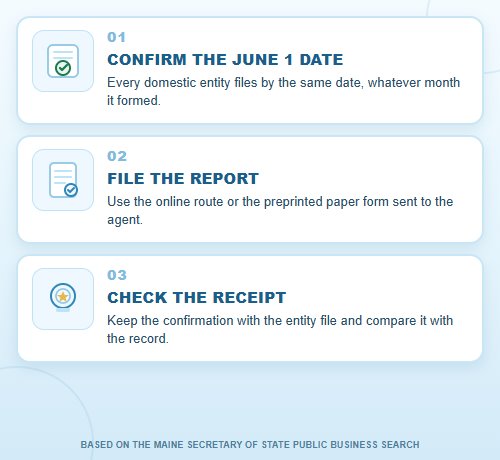
The deadline is fixed by statute and does not follow the formation anniversary. Every domestic entity, foreign entity with authority, and nonprofit corporation uses the same June 1 date, which means the division receives a year of reports in a few crowded weeks. Filing in April or early May removes the risk that a portal outage, a mail delay, or a payment problem turns a routine task into a delinquency.
Note the June 1 Deadline
June 1 is the date the report is due, not the date it must appear on the record. A report mailed on May 30 may be received in June, and a report filed online on June 2 is late even though the work took a minute. Treat the last week of May as a buffer rather than as working time, and calendar the task for the first week of April so a question about the agent or an officer can be settled without pressure.
Confirm Which Report Form Applies
The record determines the form. A domestic business entity, a foreign business entity, and a nonprofit corporation each file a different version with a different fee. A foreign entity files to keep its authority to do business in Maine rather than to keep its existence, because its existence comes from its home state. Read the entity type on the record before downloading a form, since an LLC that converted from a corporation may still be described by its old type in an old email thread.
Collect the Agent and Officer Details
The form asks for the registered agent and registered office, the principal office, a mailing address, and the officers the entity type requires. A nonprofit corporation also names its clerk. Use the details that are current on the filing date, and check the agent’s consent before naming a person who has not agreed to serve. The report confirms existing facts, so it is not the right form for a change that has a filing of its own.
Report filing:
https://apps3.web.maine.gov/nei-sos-icrs/ICRS
Preprinted forms arrive with the entity details filled in.
Choose the Online Portal or the Preprinted Form
Maine accepts annual reports online, and the portal issues a receipt when the payment clears. The division also makes a preprinted paper form available, and that form can be returned with a check or money order. Online filing suits an entity with a card and a reliable connection, while the paper route suits a filer who wants a canceled check as proof or who pays from an account that cannot use the portal.
A preprinted form is only useful if the registered office address on it is accurate. An entity that changed agents and never filed the change may still be working from a form that carries the former address, and the deadline will pass while the correction waits. Confirm the address on the record in the spring, and download a blank form from the division if the preprinted copy does not arrive.
Pay the Correct Amount
A paper filing with the wrong amount is returned rather than held, and a returned filing is not filed until it comes back with the right payment. The fee depends on whether the entity is domestic or foreign and on whether it is a business entity or a nonprofit corporation. Check the current schedule on the division site before writing the check, because a form printed in an earlier year can carry an outdated figure.
What the Annual Report Confirms
The report is a contact and governance snapshot. It tells the state who can be served, where the entity keeps its principal office, and who holds the officer roles the form names. It does not report revenue, profit, tax, employees, or owners, and it is not a financial statement. A reader who expects a balance sheet from the filing will not find one.
Registered Agent and Registered Office
The registered agent is the person or company that accepts service of process and official notices in Maine. The registered office is the Maine address where that agent can be reached during business hours. The report repeats both, which makes the annual filing a useful check on whether the agent arrangement still matches the entity’s actual operations. An agent who moved without a filing leaves the record pointing at an address that no longer works.
Principal Office and Mailing Address
The principal office is where the business is managed, and it may sit outside Maine. The mailing address is where the division sends correspondence, and it may differ from both the principal office and the registered office. Keep the three distinct when completing the form. A principal office in another state with a Maine agent is a normal arrangement for a foreign entity and needs no extra filing.
Officers, Directors, and the Clerk
A corporation names its officers and directors, and a nonprofit names its clerk along with the officers the form calls for. An LLC reports its agent, its office, and its signer rather than a board. The names on the report are the ones a searcher will see, so an entity that has changed leadership should expect the record to lag until the next report. Update the internal minute book at the same time so the two records agree.
What the Report Leaves Out
The annual report does not ask for an ownership schedule, beneficial ownership details, lender relationships, or the operating agreement and bylaws. A reader who needs to know who holds the equity has to ask the company, because the form will not supply it at any price. Treat the report as a contact record with a compliance function rather than as a disclosure document. The absence of ownership data is deliberate, since the state tracks registration rather than the private capitalization table.
Fees, Penalties, and Payment
Three rates cover most filings: one for a domestic business entity, one for a foreign business entity, and one for a nonprofit corporation. The foreign rate is higher because the filing protects authority granted in a second jurisdiction. A late penalty sits on top of the fee and applies to the entity, not to the individual who signs. Payment methods differ between the portal and the paper route, and a mismatch is the usual reason a filing bounces.
Domestic and Foreign Business Entities
A domestic entity pays the domestic rate, and a foreign entity pays the foreign rate for the same June 1 obligation. A foreign entity also files in its home state, so the Maine charge is one line in a two-state budget. Do not assume the home state report satisfies Maine or the reverse. The two filings ask for different details and run on different calendars.
Nonprofit Corporations
A nonprofit corporation pays the lowest annual rate, and its late penalty is smaller than the business penalty. The lower cost does not remove the obligation. A nonprofit with no revenue, no staff, and a dormant board still has to file, and a dormant nonprofit that stops filing will be dissolved in the same way as a trading company. Put the date in the board calendar and name a backup filer.
The Late Penalty
A business entity that files after June 1 pays a flat late penalty in addition to the annual fee. A nonprofit pays a smaller penalty on the same principle. The penalty is not a substitute for the report, so a filer cannot send the penalty alone and treat the year as closed. The division applies the payment to the filing, and an amount that covers only one part of the total is short.
A penalty follows each late report rather than the entity once. Two missed years carry two penalties, and the total grows with every June that passes without a filing. The division does not waive the charge because the report was prepared late or because a notice went astray, so the only reliable way to cap the cost is to file before the date. When a company discovers several missed years at once, ask the division for the full balance before sending a partial payment.
Underpayment and Returned Filings
A filing that arrives with too little money is returned with the deficiency noted. The entity remains delinquent while the paperwork travels back and forth, and the resubmission keeps the original problem in place if the amount is still wrong. Verify the fee on the day of filing, pay by a method the division accepts, and keep a copy of the check and the form. A returned filing is easy to fix and easy to forget.
The First Report After Formation
A new entity does not file a report in the year it is formed. The first report falls due on the June 1 that follows the formation year, which gives a new company several months to settle its agent, its office, and its officers before the state asks for confirmation. The formation filing itself is paper only and takes several business days to process, so the two obligations sit on different tracks.
Timing for a New Domestic Entity
An LLC, corporation, or partnership formed in the middle of a year still waits for the following June 1. The partial year is not prorated and no short-year report is filed. Use the gap to confirm that the charter number, the agent consent, and the office address all match what the organizer intended. A correction is cheaper before the first report than after a penalty.
Timing for a New Foreign Registration
A foreign entity that receives authority in Maine after June 1 still faces the next June 1 date. The grant of authority does not create a partial-year exemption, and the first Maine report is due with everyone else’s. Diary the date at the moment the certificate of authority arrives, because the home state calendar will not remind anyone about Maine.
A Report Is Not a Renewal
The report does not renew the entity. Existence continues until a dissolution is filed or the division acts, and authority continues until it is revoked or withdrawn. The report confirms details and keeps the record current; it does not grant a new term. A company that thinks of the filing as a renewal tends to treat a missed year as a lapse in permission rather than as the start of a dissolution.
How to Confirm the Report Posted
A report is complete when the division posts it, not when the envelope is mailed or the card is charged. Processing adds days to the calendar, and the posted date can fall after June 1 even when the filing arrived before the deadline. The receipt is what proves timely delivery, and the record is what proves the state accepted the filing. Keep both.
Search the Entity Record
Open the record by entity name or charter number through a Maine company search and read the filing history beneath the summary. The newest annual report appears as its own line with a posted date. If the line is missing, the filing has not posted, even when the payment cleared. Compare the number of report lines with the number of years the entity has existed to spot a gap.
Read the Dates in the History
The posted date is when the division keyed the filing, and it can differ from the date on the receipt. A report received on May 28 and posted on June 4 is timely on the receipt and late-looking on the record. Keep the acknowledgment with the report copy so a later question about the deadline can be answered with the date the division received the envelope.
Save a dated copy of the record when the report posts. The search result can change with the next filing, and a printed page with the retrieval date is easier to defend than a description of what the screen showed six months earlier. Attach it to the acknowledgment so the receipt and the record sit together in one place and can be produced at the same time.
Keep the Acknowledgment
An online filing produces a confirmation screen and often an email. A paper filing produces a canceled check, a money order stub, or a certified mail receipt. Store the proof with the annual report copy in the entity binder. A lender or a buyer who reviews compliance will ask for the last two or three acknowledgments, and reconstructing them after a bank change is harder than filing them once.
After a Missed Report
A missed report does not end the entity on June 2. The division treats the entity as delinquent and may send a notice to the registered office, but a stale address can swallow the warning. If the report stays unpaid, the division moves to an administrative action that ends the registration. The record then shows a closure the company did not vote for.
Administrative Dissolution
Administrative dissolution ends a domestic entity by action of the state rather than by a vote of its owners. The entity stops being a registered business in Maine, and the name may later be claimed by another filer. A dissolved entity cannot keep trading under the old charter and promise to catch up. The cure is a reinstatement application with the missing reports and the penalties attached.
Revocation of Foreign Authority
A foreign entity that ignores the Maine report loses its certificate of authority. The entity still exists under the law of its home state, but it may not hold itself out as authorized in Maine until the authority is restored. A lender that checks the Maine record will see the revocation even when the home state record looks clean, which makes the Maine filing a visible weak point in a multistate file.
Reinstatement and Back Reports
Reinstatement is not a single form. The entity files the reports it skipped, pays the penalties for each, and submits a reinstatement application. The charges stack, so a company that missed three years pays for three reports plus three penalties before the record returns to good standing. A Maine business status check before the application shows exactly which years are missing and whether the name is still available.
Rebuilding the Record After Reinstatement
Reinstatement adds a new line to the history; it does not erase the gap. The record will show the missing years, the administrative action, and the cure, and a careful reader will ask about the sequence. Prepare a short written account of why the reports lapsed and what changed, and keep it with the closing file. That account is a business document, not a state filing, and it prevents the same gap from becoming a negotiation point twice.
Maine Annual Report Fees
The table lists the four amounts a filer needs for the June 1 cycle: the domestic rate, the foreign rate, the nonprofit rate, and the late penalty for a business entity. The division sets these by statute, and the portal or the paper form collects them at the time of filing. A nonprofit penalty is assessed at a lower figure than the business penalty and is not shown here.
| Filing | Fee | Notes |
|---|---|---|
| Domestic annual report | $85.00 | Domestic LLC, corporation, LP, or LLP |
| Foreign annual report | $150.00 | Registered to do business here |
| Nonprofit annual report | $35.00 | Nonprofit corporation |
| Late penalty | $50.00 | Business entities; added to the report fee |
A filer who owes a fee and a penalty should send both in one payment and note the report year on the check. A payment that covers the fee but not the penalty leaves the filing open, and a payment that covers the penalty but not the report leaves the entity delinquent. Confirm the total with the division when the account has been late for more than one year, because the back reports multiply the amount.
Frequently Asked Questions
These questions come from owners and office managers who file the report each spring. Each answer points back to the deadline, the form, or the record rather than to a general rule.
When is the Maine annual report due?
The report is due on June 1 every year. The date is the same for domestic entities, foreign entities with Maine authority, and nonprofit corporations, and it does not shift with the formation anniversary. Filing in April avoids the late-May rush.
Can the Maine annual report be filed online?
Yes. The division accepts annual reports through its online filing system, and the portal gives a receipt once payment clears. A preprinted paper form is also available from the division and can be returned with a check or money order.
What happens when the June 1 deadline is missed?
The entity becomes delinquent and a late penalty is added to the report fee. If the filing stays unpaid, the division may dissolve a domestic entity or revoke a foreign entity’s authority. Reinstatement then requires the missing reports, the penalties, and an application.
Does a new Maine LLC file a report in its first year?
No. An entity formed during a calendar year files its first report on the June 1 that follows the formation year. The stub period does not create an extra filing before that date.
How can a filer prove the report was filed on time?
Keep the online confirmation, the canceled check, or the certified mail receipt, and compare it with the posted date in the filing history. The receipt shows when the division received the filing, while the record shows when the division accepted it.