

Maine business filing fees are set by statute, not negotiated by the office that collects them. The Division of Corporations, UCC and Commissions charges what the legislature has enacted, and the same amount applies to a two-person LLC and a national company registering in the state. That makes the schedule predictable, and it makes the statute the place to look when a figure on an old form no longer matches the current price.
This page is the cost reference for the register. It covers the formation and qualification charges, the annual report rates, name filings, certificates and copies, amendment and closure charges, and the expedited service that moves a submission to the front of the queue. It also shows how a late penalty and a reinstatement combine when a filing year is missed. The schedule is set out in the table below.
How to Read the Maine Filing Fee Schedule
The amounts come from three bodies of law. Title 13-C governs business corporations, Title 13-B governs nonprofit corporations, and Title 31 governs LLCs, limited partnerships, and limited liability partnerships. The division applies the schedule as written, so a filer who believes a charge is wrong is usually comparing an old form with a new statute rather than finding an error at the counter.
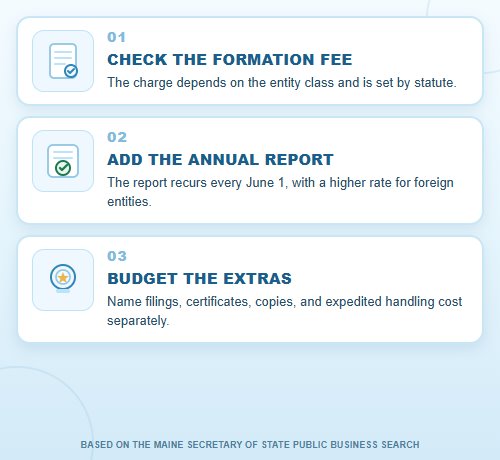
Fees Set by Statute
A statutory fee changes only when the legislature amends the section that sets it. The division cannot discount a charge for a small business, a startup, or a nonprofit that is short of funds, and it cannot accept a partial payment in exchange for a promise to pay the rest. When a fee change takes effect, paper forms printed earlier may still be in circulation. Check the current figure on the division site on the day of filing and pay that amount, not the amount remembered from a prior year.
Paper Formation and Online Reports
Formation and qualification filings are paper only, submitted by mail or at the counter in Augusta. Annual reports can be filed online, and the portal takes payment at the time of submission. Certificates, copies, and certified copies are ordered by mail or at the counter. The channel matters for the budget because it decides which payment methods are available and how much time the filing spends in transit before it reaches the queue.
Fee schedule:
https://apps3.web.maine.gov/nei-sos-icrs/ICRS
Rates rest on statute rather than on office discretion.
Processing Time and the Expedite Charge
Standard processing of a paper filing runs two to seven business days after the division receives it. Mail time sits outside that window, so a document mailed on a Friday may not enter the queue until the middle of the following week. Rush handling is a separate charge that cuts queue time: one choice finishes the next business day, the other the same day. The charge is collected per submission and does not change the filing fee itself.
What the Fee Does Not Cover
A state filing fee buys the filing, not the business. It does not pay Maine taxes, obtain a license, satisfy a municipal permit, or cover the registered agent’s own charge. It also does not buy legal or accounting work. A budget that counts only the division’s formation fee will understate the cost of starting a company, because the agent charge and professional advice sit outside that fee, and the first annual report arrives the following year.
Formation and Qualification Charges
The first charge a new entity pays is the formation filing, and the amount depends on the entity type rather than on the size or purpose of the business. A corporation, an LLC, a nonprofit corporation, an LP, and an LLP each have their own line. A foreign entity pays a qualification charge instead, which is the highest single filing on the domestic schedule and buys authority rather than existence.
LLC and Corporation Filings
An LLC files a certificate of formation, and a business corporation files articles of incorporation. The two charges differ, with the corporate filing lower than the LLC filing. A nonprofit corporation files articles of incorporation under the nonprofit statute at a much lower rate. Before choosing a name for any of them, run a Maine company search to see whether the name is already on the register, because a rejected filing still costs time and a corrected one costs a second submission.
Partnership Filings
A limited partnership files a certificate of limited partnership, and a limited liability partnership files its own registration. Both sit at the same level as the LLC charge. The partnership forms carry different governance terms from an LLC, and the filing fee does not signal which structure is better for a given business. Compare the liability rules and the tax treatment first, then pay the charge that matches the choice.
Foreign Qualification
A foreign entity that wants authority to do business in Maine pays the qualification charge, which is higher than any domestic formation fee. The entity also pays its home state’s annual or formation costs, and it takes on the Maine annual report obligation once authority is granted. Budget the two states together. A company that registers in Maine because of one contract should confirm that the contract requires registration before adding a permanent compliance obligation.
Why Formation Is Paper Only
The division does not accept formation filings through the online portal. The signed document goes by mail or over the counter, and the paper route is part of the schedule rather than an oversight. A filer should add mail time to the processing window and should send the correct number of copies if the instructions ask for them. A commercial filing service can prepare and deliver the paper, but its charge is separate from the state fee and does not shorten the division’s review.
Recurring Charges: Annual Reports
The annual report is the charge that recurs, and it is due on June 1 for every entity on the register. Domestic business entities pay one rate, foreign business entities pay a higher rate, and nonprofit corporations pay the lowest rate. A late report adds a flat penalty to the fee, and a long delinquency adds reinstatement to the total.
Domestic and Foreign Rates
A domestic LLC, corporation, LP, or LLP pays the domestic annual rate. A foreign entity with Maine authority pays the foreign rate, which is close to double. The difference reflects the two-state nature of a foreign registration: Maine charges for the authority it supervises, while the home state charges for existence. Both reports fall due on the same date, so a foreign entity should calendar one reminder that covers both filings.
Nonprofit Rates
A nonprofit corporation pays the lowest annual rate and the lowest late penalty. The reduced schedule does not create an exemption. A nonprofit with no paid staff and no revenue still files each year, and a board that treats the report as optional will eventually face administrative dissolution. Put the filing in the board minutes and assign a backup preparer so a change of officers does not drop the obligation.
The Late Penalty
The penalty is flat and applies to each late report rather than once to the entity. A business entity pays one penalty figure and a nonprofit pays a smaller one, both in addition to the report fee. The division does not waive the charge because the notice went to an old address or because the treasurer changed. A penalty paid without the report leaves the entity delinquent, so the payment should cover both parts in one submission.
Reinstatement and the Stack
If reports stay unpaid, a domestic entity can be dissolved and a foreign authority revoked. Revival then needs the skipped reports, the penalty for each, and a revival charge. The amounts stack: three missed years mean three report fees, three penalties, and the reinstatement charge before the record returns to good standing. That total is usually far above the cost of filing on time, which is why a cash shortage is a poor reason to skip a report.
Name Filings and Assumed Names
Name filings are separate from formation and carry their own charges. A reservation holds a name while the organizer prepares the formation document, and an assumed name registration lets an existing entity trade under a second name. Neither creates an entity, and neither substitutes for the formation filing that gives the business its legal existence.
Name Reservation
A reservation gives the applicant a short exclusive claim on a name before the formation document is ready. The charge is modest for a business entity and lower for a nonprofit. A reservation is useful when a lease or a contract depends on a name that is about to be used, but it does not reserve the name forever. Confirm the spelling and the designator before submitting, because a reservation of the wrong name is money spent on a name the entity will not use.
Assumed Name Registration
An assumed name registration lets an entity conduct business under a name different from its legal name. The charge is higher than a reservation, and the nonprofit rate is reduced. The registration is filed under the entity’s charter number and appears in its own record. A business that signs contracts under a trade name should complete the registration before the first signature, because the legal name and the trading name are different facts in a dispute.
Checking a Name Before Paying
The register is public, and a name check costs nothing. Search the exact spelling, the likely variants, and the designator the entity intends to use. A name that is already registered will not be approved for a new entity, and a reservation does not override an existing registration. Do the check before the reservation charge is paid, and keep a screenshot of the result in the formation file so the organizer can show what was reviewed.
Certificates, Copies, and Certification
Documents ordered after formation carry separate charges. A certificate of existence states the entity’s position on a date, a plain copy reproduces a filed page, and a certified copy adds a stamped statement that the copy matches the original. The certificate is priced per document, while copies and certification are priced per page or per copy.
Standing Certificates
A certificate of existence is the standard document for a bank, a buyer, or another state’s registry. The business entity rate is higher than the nonprofit rate, and the charge is the same whether the certificate is for a domestic entity or a foreign entity with Maine authority. A certificate of fact or a certificate of authority comes from the same family and carries a comparable charge. Time the certificate to the review date.
Page Copies
A plain copy is charged by the page, so the length of the document drives the cost. A short amendment is inexpensive, while a long merger document with exhibits can run to many pages. Confirm the sheet count before a large order is run, and consider whether the recipient needs every exhibit or only the pages that carry the operative terms. The page charge applies to each sheet supplied.
Certification per Copy
Certification is a separate charge on top of the page charge, applied to each copy that carries the attestation. A certified copy of a ten-page document therefore costs the certification charge plus ten page charges. Certification is what a court, a recording office, or a lender accepts when the text of the document matters. A plain copy of the same pages is cheaper and is fine for an internal file.
Planning a Document Order
Combine the certificate and the certified copies in one request so the division handles them together. State the entity, the charter number, each document by type and date, and whether certification is wanted. A single complete request is cheaper and faster than three partial ones, each with its own handling and postage. Keep the receipt with the documents, because it shows what was ordered and what was paid.
Amendments, Endings, and Other Charges
Changes to a filed record and closures of an entity carry their own charges. An amendment is not covered by the annual report fee, and a dissolution is not covered by the final report. A company that plans to change its name, its agent, or its share structure should budget the amendment alongside the report rather than treating the two as one filing.
Amendments
A change to a term in the formation paper, such as the name or share count, is priced separately. It has a flat charge and a paper filing, and it posts as its own line in the history. The annual report cannot be used to make the change, even when the report is filed in the same week. File the amendment first, then file the report with the updated details so the two records agree.
Dissolution and Cancellation
A corporation ends with articles of dissolution, and an LLC ends with a cancellation of its certificate. Both carry a flat charge that is lower than a formation fee but higher than an amendment. The filing closes the record, and a final annual report may still be due for the year of closure. A business that stops operating without filing the closure remains on the register and keeps accruing report obligations.
Foreign Withdrawal
A foreign entity that leaves Maine files an application for withdrawal to end its authority. The filing has its own charge and should be made after the final Maine report is settled. Withdrawal is not the same as dissolution, because the entity continues in its home state. A company that closes the home entity first leaves the Maine authority orphaned and creates a record that is harder to clean up later.
Comparing Closure and Reinstatement
A dormant entity faces a choice: pay the back reports and penalties to restore it, or close it and form a new one if the business returns. Compare the full reinstatement total with the cost of a fresh formation plus the loss of the charter number and the history. A buyer reviewing Maine LLC records will see a gap followed by a closure, so the cheaper option is not always the cleaner one for a company that expects to trade again.
Expedited Service
Expedited handling is a queue charge rather than a different review. The filing still has to be complete, signed, and paid at the correct rate. What changes is the order in which the division works on it. The charge is collected per submission, so a packet with three filings is priced as one expedited submission rather than three if it is submitted together.
Next Business Day
The lower expedite option moves a submission ahead of standard work for completion on the next business day. It fits a filing that missed a mail deadline or a closing that moved forward by a week. The request must be marked clearly, and the expedite charge must accompany the filing. A submission that arrives after the daily cutoff may be treated as received the following day, which pushes the completion date.
Same Day
The higher expedite option targets completion on the same day the submission is accepted. It is the option for a court date, a funding deadline, or a registry that closes at the end of the day. Same-day service still depends on a complete filing and available staff, and it does not guarantee a result when the document has a defect. Confirm the cutoff time with the division before relying on it.
When Expediting Is Worth the Charge
Expedite pays when a third party is waiting and the delay has a cost that exceeds the charge. It does not pay for a filing that can sit for a week, and it cannot rescue a document that will be rejected for a missing signature or an incorrect fee. Fix the defect first, then decide whether the queue charge is needed. A rejected expedited filing still consumes the charge and the day.
The Full Fee Schedule
The table collects the charges discussed above: formation and qualification, annual reports, name filings, the standing certificate, late penalties, and expedited handling. The division sets these amounts by statute and collects them at the time of filing. A figure that differs from an older form should be checked against the current schedule before payment.
| Filing | Fee | Notes |
|---|---|---|
| LLC certificate of formation | $175.00 | Domestic LLC; paper filing |
| Corporation articles | $145.00 | Domestic business corporation |
| Nonprofit articles | $40.00 | Nonprofit corporation |
| LP certificate | $175.00 | Limited partnership |
| LLP certificate | $175.00 | Limited liability partnership |
| Foreign qualification | $250.00 | Authority to do business in Maine |
| Domestic annual report | $85.00 | Due June 1 each year |
| Foreign annual report | $150.00 | Entity with Maine authority |
| Nonprofit annual report | $35.00 | Due June 1 each year |
| Name reservation | $20.00 | Business entity; reduced for nonprofits |
| Assumed name | $125.00 | Registration to trade under another name |
| Certificate of existence | $30.00 | Business entities; reduced for nonprofits |
| Late penalty | $50.00 | Business entities; each late report |
| Late penalty | $25.00 | Nonprofit corporations; each late report |
| Expedited service | $50.00 | Next business day |
| Expedited service | $100.00 | Same day |
A budget should separate the one-time charges from the recurring ones. Formation, qualification, name filings, and the first certificate are start-up costs, while the annual report and its penalty are recurring. The expedite charge is optional and belongs in a contingency line rather than in the base cost. A filer who adds the recurring charges to the start-up total gets a figure that is closer to the true first-year cost than the formation fee alone.
Frequently Asked Questions
These questions come from organizers, buyers, and bookkeepers who are pricing a filing or checking an invoice. Each answer points to the schedule or to the office that collects the charge.
Where do Maine business filing fees come from?
The amounts are set by statute in Title 13-C for business corporations, Title 13-B for nonprofit corporations, and Title 31 for LLCs and partnerships. The Division of Corporations, UCC and Commissions collects them as written.
Can a Maine formation filing be submitted online?
Annual reports go through the online system. Formation and qualification documents still travel on paper, by mail or over the counter.
How much does it cost to keep an LLC registered in Maine?
The recurring cost is the annual report, due June 1. A late report adds a penalty, and a long delinquency adds reinstatement charges. The table above lists the report rate and the penalty figure.
Does expedited service change the filing fee?
The rush price sits apart from the filing fee and applies once per batch. Choose the one-day option or the same-day option when the deadline demands it.
Are nonprofit filing fees lower in Maine?
Yes. Nonprofit articles, annual reports, name reservations, assumed names, and certificates carry reduced rates. The nonprofit late penalty is also lower than the business penalty.