
Partnership records in Maine sit in the same portal as corporations and LLCs but follow a different logic. A limited partnership is built around two classes of owners, and the state file reflects that split by naming the general partners while leaving the limited partners largely out of view. A limited liability partnership is a different animal altogether, usually a professional firm that registers rather than incorporates. Reading either record correctly means knowing which document created the entity and which fields the state actually collects.
Buyers, lenders, and lawyers run into trouble when they treat a partnership file like a corporate file. There is no board, no shareholder list, and often no public record of who owns what percentage. The registration proves existence, identifies who is responsible for management, and shows whether annual reports are current. Everything else about the economics of the deal lives in a partnership agreement that the state never sees and cannot disclose.
How to Search Maine Partnership Records
The search interface is the Interactive Corporate Services system operated by the Secretary of State. It indexes limited partnerships, limited liability partnerships, limited liability limited partnerships, and the foreign versions of each. Enter a name in the entity search field and the system returns every match with its type, charter number, and status. From there, a detail page lists the formation date, the jurisdiction, the registered office, and the most recent annual report. No login is needed, and results are free to view.
Partnership table:
https://apps3.web.maine.gov/nei-sos-icrs/ICRS
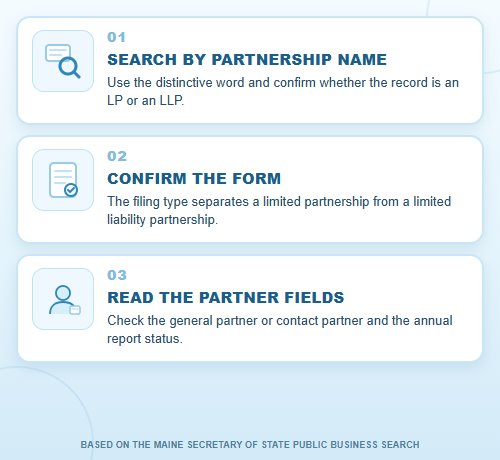
Partnership files name the general or contact partner.
A partnership name search can be frustrating because firm names evolve. Professionals merge, drop a founding partner’s surname, or add a practice area to the letterhead without amending the certificate. The legal name on file may be a string of surnames separated by commas and the word Associates. Searching a distinctive surname from the letterhead, or the town where the office sits, often finds the record faster than typing the full marketing name into the box.
Searching by Entity Name
The name field supports partial matching, so a fragment like a first surname plus the word partnership will usually return a workable list. Each row displays the entity type, which matters more than the name. A result labeled limited partnership is governed by one statute and a result labeled limited liability partnership by another. Clicking through to the detail page confirms the type and shows whether the registration remains active, which is the first fact any counterparty needs.
Reading the Filing Type Field
The filing type field is the clearest signal of what you are looking at. Maine registers domestic limited partnerships by certificate, domestic limited liability partnerships by registration, and foreign entities of either kind by application. A record that reads limited liability limited partnership reflects an election layered onto a limited partnership. A reader who wants the wider register can begin with the Maine company search results and filter by class, which avoids guessing at abbreviations the portal may not use.
The Certificate of Limited Partnership
A Maine limited partnership begins with a certificate of limited partnership filed on paper with the Secretary of State. The certificate is a modest document. It states the name, the address of the registered office, the name and address of the registered agent, the name and business address of each general partner, and the latest date on which the partnership is to dissolve if one is specified. It does not include the partnership agreement, and it does not list limited partners.
That omission is deliberate. Limited partners are investors, often passive, and the statute does not require their identities in the public file. The certificate is signed by all general partners, which makes it a useful check on who had authority at formation. If the record shows a single general partner, the entity is a one-person general partner structure regardless of how many investors stand behind it. Amendments update the general partner list when a firm reorganizes.
What the Certificate Contains
Beyond names and addresses, the certificate carries the partnership’s registered agent, the agent’s consent, and a dissolution date if the partners fixed one. Some certificates include a statement of the purpose, though Maine does not demand a detailed purpose clause for a limited partnership. The filing fee is set by statute, and a rejected certificate is returned with the defects noted so the filer can correct and resubmit. Because the document is short, a certified copy is easy to read in full, and reading it is worth the small charge.
General Partners and Limited Partners
A general partner manages the business and bears liability for its obligations. A limited partner contributes capital and, in the usual arrangement, stays out of day-to-day management in exchange for liability limited to the invested amount. Maine law codifies that bargain. When a limited partner begins acting like a manager, the protection can be lost, and courts have looked past the label when the facts showed control. The public record will not reveal that behavior, but it will show who signed as general partner.
This division is why the certificate names general partners and stops there. The state is identifying the people who can bind the entity, not cataloguing the investors behind it. A lender evaluating a limited partnership will ask for the partnership agreement to learn the capital structure, the distribution waterfall, and the limits on the general partner’s authority to borrow. None of that appears in the portal, and no amount of searching will surface it.
The general partner is sometimes another entity, such as an LLC formed to hold the general partner interest. The record then shows the LLC’s name and address rather than an individual. That structure is a signal worth following: trace the general partner LLC through the same portal to learn who manages it. A chain of entities can be legitimate asset planning or a way to distance a promoter from liability, and the filing history usually suggests which reading fits.
Registering a Limited Liability Partnership
A limited liability partnership is not formed by certificate in the way a limited partnership is. Existing general partnerships, and in practice many professional firms, register with the state to obtain liability protection for partners against certain claims. The registration states the firm’s name, the address of its principal office, the name and address of a contact partner, a brief statement of the business, and the number of partners. It is renewed through the annual report rather than expiring on its own.
Accounting firms, law firms, and consulting practices are the familiar users of this form. The registration does not create a new legal person; the partnership continues as it was, now with a public registration that shifts some liability consequences. Because the underlying partnership agreement remains private, a searcher sees the registered facts but not the ownership split, the capital accounts, or the compensation formula. The record answers who to serve and whether the firm is current, not who earns what.
The Contact Partner
The contact partner is the individual the state corresponds with about the registration. That name is public and is often the most useful field on the page, because it identifies a real person with a real address rather than a firm name. Service of process still goes to the registered agent or registered office, but notices about annual reports and renewals go to the contact partner. If a firm changes that person, an amendment keeps the record accurate.
The LLLP Election and What It Changes
Maine allows a limited partnership to elect limited liability status, producing a limited liability limited partnership. The election extends protection to the general partners, who otherwise carry unlimited liability for partnership obligations. The entity remains a limited partnership in structure, with general and limited partners, but the general partner’s exposure narrows. The election is filed with the state, and the record should then show the LLLP designation in the entity type or name.
For a searcher, the practical consequence is that an LLLP file looks almost identical to an LP file apart from the type label. The same general partners appear, the same annual report obligation applies, and the limited partners stay off the record. The difference matters when assessing risk: a claim against an LLLP reaches the entity’s assets before it reaches a general partner’s personal assets, subject to the limits in the statute. Confirm the designation on the current record rather than relying on a letterhead.
Telling an LP From an LLP in the Record
Three fields separate the two forms. First, the entity type, which the portal prints as limited partnership, limited liability partnership, or limited liability limited partnership. Second, the formation document named in the filing history, a certificate for an LP and a registration for an LLP. Third, the officer language, since an LP lists general partners while an LLP lists a contact partner and a partner count. Reading those three together removes any ambiguity a name alone creates.
Names are unreliable because firms use partnership loosely. A professional corporation may trade as a partnership, and a limited liability company may call itself a partnership group. The portal only reflects what was filed. When a contract names an entity and the type in the record conflicts with the type in the contract, ask for the certificate or registration and reconcile the mismatch before signing. A signature from someone who is not a general partner can leave the entity unbound.
Annual Reports and Foreign Qualification
Both forms file an annual report with the Secretary of State, due June 1, and both pay the same charge for it. The report updates addresses, the agent, and for an LLP the contact partner and partner count. Filing online is available. A partnership that ignores the deadline accrues a penalty and can be administratively revoked or dissolved. Reinstatement is possible, but the gap stays visible in the filing history and can complicate a closing that requires clean standing.
A partnership formed elsewhere that operates in Maine registers as a foreign limited partnership or foreign limited liability partnership. The application identifies the home jurisdiction and appoints a Maine agent. The home state’s law continues to govern internal affairs, so Maine does not review the partnership agreement or the capital structure. The Maine file confirms authority to do business, the agent, and annual compliance. Nothing more about the entity’s internal economics becomes public through registration.
Late Reports and Revocation
A partnership that skips its report does not vanish quietly. The state marks the entity in default, adds a penalty, and after a period of inactivity revokes or dissolves the registration. A revoked partnership may not maintain an action in Maine courts until it is restored, which can stall a collection suit or a construction claim at the worst moment. Revival needs the skipped reports, the penalties, and a separate filing. Because the revocation date stays on the record, a counterparty can see exactly how long the firm operated without authority.
Where the Registered Agent Fits
The registered agent is the person or company designated to accept service of process and official notices. That address is public, and it is the address a plaintiff uses when suing the firm. An agent can be a partner, an employee, or a commercial service that charges an annual retainer. The agent must consent in writing, and the consent is filed with the state. If the agent moves or resigns, the partnership must appoint a replacement and file the change, usually through an amendment.
Searchers sometimes mistake the registered office for the firm’s actual place of business. The two can be identical, but a commercial agent’s address tells you nothing about where the partners work or keep records. A firm that lists a mail drop in a capital city may operate entirely elsewhere. Treat the agent address as a legal channel for documents rather than a physical location, and ask the firm directly for its operating address when that detail matters to a site visit or a delivery.
Partner Departures and Amendments
When a general partner leaves, retires, or is removed, the certificate must be amended. Until the amendment is accepted, the departing partner may still appear as an authorized manager, which creates real risk if that person signs a contract after leaving. A cautious counterparty asks for the amendment and a current certificate rather than accepting a verbal assurance that the roster changed. The filing history shows the sequence of amendments, and gaps in that sequence are worth questioning.
Admission of a new general partner follows the same path. The partnership agreement usually governs the vote required, and the amendment records the result. Limited partner transfers generally do not trigger an amendment because limited partners are not on the certificate at all, though the agreement may require notice or consent. That asymmetry is one reason buyers should read the agreement instead of relying on the public file, since the file can show a stable general partner while the ownership beneath it has changed hands twice.
What a Claimant Checks
A person with a potential claim reads the same record with different questions. Is the registration active, and if not, when was it revoked? Who is the general partner, and is that general partner an entity with its own registration? Does the partnership carry insurance, and is the policy still in force? The portal answers the first two and nothing about the third. A claimant who serves process on the registered agent has done the procedural part correctly, but recovery depends on assets that the public file does not inventory.
For a limited partnership, the general partner’s personal exposure is the traditional backstop, reduced where an LLLP election applies. For a limited liability partnership, the statute shields partners from certain claims while leaving the firm’s own assets exposed. Those differences shape strategy, and they turn on the entity type printed in the record. Confirm the type and the election status before assuming who stands behind an obligation. A letterhead or a website will not settle the question.
What a Buyer Should Request
Someone acquiring a partnership interest or buying the firm outright should not rely on the portal alone. Request the certificate or registration as amended, a current certificate of existence, the partnership agreement with every amendment, and the last several annual reports. Add a UCC search for secured debt, a tax status letter, and evidence of insurance. If the general partner is an entity, request its own formation documents and a resolution authorizing the transaction. These items together answer questions the state file cannot.
The partnership agreement carries the provisions that decide whether a deal is even possible: consent thresholds, transfer restrictions, buyout formulas, and deadlock remedies. A buyer who skips it may discover that a single limited partner can block the transfer or that a right of first refusal applies. For background on how the state treats the LLC form that often sits behind a general partner, the parallel Maine LLC records show formation details and annual report history that clarify the chain of control.
Set expectations with the seller early. Sellers often produce a one-page summary and assume that satisfies diligence, while a buyer needs the underlying documents. Ask for a complete index of filings, including any amendment that was prepared but never submitted, and compare that index with the state history. Discrepancies are not necessarily misconduct; they may reflect an address change nobody bothered to file. Either way, resolve each one in writing before funds move, and hold back part of the price until the record matches the documents.
Fees for Partnership Filings
The state charges fixed amounts for partnership documents, and the totals differ by form. The table below lists the filings most often needed by new firms and by existing partnerships updating their records. Mail a paper filing with the exact amount, and confirm the current schedule before sending a payment for a document not shown here.
| Filing | Fee | Notes |
|---|---|---|
| LP certificate of limited partnership | $175.00 | Paper filing with the Secretary of State |
| LLP registration | $175.00 | Certificate of limited liability partnership |
| Annual report | $85.00 | Due June 1 for both forms |
| Amendment | $50.00 | Updates partners, agent, or addresses |
Ordering Copies and Certified Records
The portal displays summary data, and a transaction may call for something more formal. A certified copy of the certificate or registration carries the state’s seal and a signature, which some lenders and title companies require. Copies are billed per page, and certification adds a separate charge per copy, so a long amended certificate costs more than a single-page registration. Request the certificate of existence at the same time to confirm current standing without a second round of correspondence.
Paper requests take longer than online orders, and processing times of several business days are normal for documents that must be pulled and certified by hand. Build that delay into a closing schedule rather than assuming a same-week turnaround. Expedited service is available for an added charge, with tiers for next business day and same day handling, and the charge applies per entity for documents submitted together. For a deal on a tight calendar, that option is often cheaper than the cost of a delayed closing.
Frequently Asked Questions
These are the questions that arise most often when a partnership record is read for the first time.
Does the state publish a list of limited partners?
No. The certificate names general partners, and limited partners are not part of the public filing.
How can I tell an LP from an LLP?
Check the entity type, the formation document, and whether the record names general partners or a contact partner.
Is an LLLP a separate entity type?
It is a limited partnership that elected limited liability status, shown on the record with its own designation.
When is the partnership annual report due?
June 1 each year, and it can be filed online.
Can I see the partnership agreement through the portal?
No. The agreement is private and must be requested from the partnership itself.