

Maine business status is a field on a state record, not a verdict about a company. The field reports whether the Division of Corporations, UCC and Commissions still treats the entity as registered, and it changes when the entity files, stops filing, closes on purpose, or is closed by the state. A search returns that field in seconds, costs nothing, and needs no account, which is why it is the first thing most buyers, vendors, and lenders check.
This page deals with status alone: the values Maine uses, the annual report cycle behind them, the delay between a filing and a status change, reinstatement, and the difference between a status line and a certificate of existence. It also sets out what a status cannot prove, because a reader who treats an active record as a clean bill of health will draw the wrong conclusion. Fees for the filings behind a status change are in the table.
How to Check Maine Business Status
The state portal gives a list of matches with the standing shown next to each name. A reader can begin with a word, a number, or a document class, and the result set is the same register that holds corporations, LLCs, nonprofits, and partnerships. The search is public, and the detail page shows the current status without a request form or a fee.
Search by Legal Name
Enter the distinctive part of the name and leave the ending out on the first attempt. Maine stores “Inc.”, “LLC”, “Corp.”, and “Limited Partnership” in the name field, but punctuation and abbreviation are matched unevenly, so a query that includes the ending can miss the record it was meant to find. A word tied to the trade, a town, or a family name usually returns a workable list.
When the list is long, scan the status column before opening anything. A name shared by an active company and a dissolved one is a sign that the register has carried several entities under similar words, and the charter number is what separates them. Two records with near-identical names in different counties are usually unrelated businesses that chose the same trade word.
Search by Charter Number
The charter number is the exact key. Maine assigns it when the entity is created, prints it on the acknowledgment, and carries it through every later filing, so a name change or a move does not disturb it. Enter the number without spaces or punctuation. A single wrong digit returns an empty page that looks like a company that never existed.
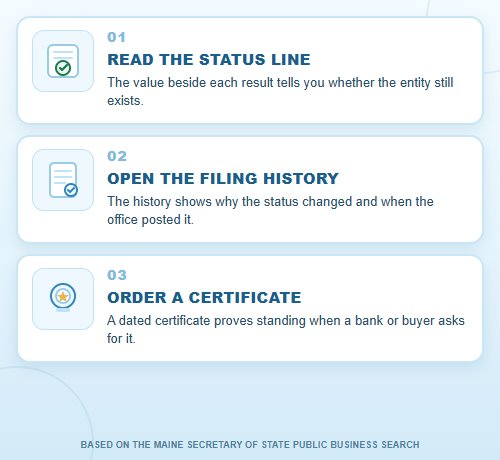
Read the Status Field
The status sits near the top of the detail record, beside the filing type and the formation date. Maine uses a small set of values, and each one describes the state’s own posture rather than the health of the business. A company can be active and insolvent, or dissolved and still trading under a second entity with a similar name.
Read the status with the report date beside it. An active record whose last report posted years ago is a different picture from an active record whose report posted last month, even though the word on the line is identical. The date tells you when the state last heard from the company, and that is often the more useful fact. A reader who wants the wider index can start with a Maine company search and then narrow the list by charter number.
Status board:
https://apps3.web.maine.gov/nei-sos-icrs/ICRS
Status lines post after processing, not on mailing.
Compare Results Before Opening a Record
The list view and the detail view can disagree for a short period after a filing is accepted. The list is built from an index that refreshes on its own schedule, while the detail page reads the record itself. When the two differ, trust the detail page and note the date you read it, because the next reader may see the other value and reach a different conclusion.
What Active Means on a Maine Record
Active means the entity is on the register and the division has not closed it. That is the whole of the claim. It carries no statement about tax payment, licensure, insurance, or solvency, and it does not confirm that the people named on the record still control the company.
Active and Current
An active record with a recent annual report is the ordinary case for a business in operation. The agent and office on the record are likely to be accurate, the charter number is live, and a certificate of existence will issue without trouble. A buyer can rely on such a record for the limited purpose of confirming registration.
Active With an Overdue Report
Maine does not switch the status on the day a report is missed. The entity stays active while the division processes the delinquency, which means an active status can sit on a company that is already behind. The report date on the record is the clue: a gap of more than a year against a June 1 cycle is worth a direct question.
Ask the seller for the filing receipt rather than the record alone. A report mailed before the deadline and posted after it looks late on the record and was not late in fact. The receipt settles the matter in a way the status line cannot, and it takes one request to obtain.
Status on a Nonprofit Record
A nonprofit corporation carries the same status values as a business corporation, and the field is read the same way. The difference sits behind the label: the annual report runs on a lighter fee scale, the late penalty is smaller, and the reinstatement schedule is built per report rather than as a flat charge. A reader comparing a nonprofit and a business entity side by side should not expect the balances to match.
What Inactive and Dissolved Mean
Inactive and dissolved are related but not identical. Inactive usually marks an entity that has stopped filing or has been flagged by the division without a final closure, while dissolved marks the end of the entity’s registered life. Both remove the company from good standing, and both can be cured, though the path and the cost differ.
Inactive Records
An inactive record may still carry open obligations. The division can mark a company inactive while a report or a penalty remains unpaid, and the record will show the last document received. Treat inactive as a warning rather than an ending, and read the history before assuming the company is gone.
Voluntary Dissolution
A company that files articles of dissolution ends its registered life on purpose. The filing states the name, the charter number, and the effective date, and it usually confirms that debts are provided for. A voluntary dissolution is a clean ending: the record shows the filing, the status changes, and no penalty accrues afterward.
Administrative Dissolution
Administrative dissolution is the state’s action, not the company’s. Maine takes it after annual reports and penalties go unpaid long enough, and the division issues notice before the change takes effect. The record then shows dissolved, and the entity loses the ability to sign new contracts or sue in its own name within the state.
The distinction matters in a dispute. A voluntarily dissolved company chose to stop; an administratively dissolved one was stopped. The filing history shows which happened, and the presence or absence of a dissolution filing is the tell. A record with no dissolution filing and a dissolved status points to the administrative route.
The Annual Report Cycle That Drives Status
Almost every status change traces back to the annual report. Maine sets one deadline for the year, and the division measures delinquency from that date rather than from the formation anniversary. A company formed in October still files by the following June 1, which surprises owners who expect a full twelve months.
The June 1 Deadline
The first of June is the fixed date for every domestic entity, and the preprinted form usually reaches the registered agent before that. The report confirms the agent, the office, and the principal address, and it carries the entity’s own charter number. A report that arrives after the date is treated as late even when the envelope shows an earlier postmark.
The Late Penalty
A missed report adds a penalty to the report fee, and the penalty recurs with each cycle that passes without a cure. The amount differs for a business entity and a nonprofit, and the table below sets out both. Paying the penalty does not remove the late mark from the history; it only clears the balance and stops the next penalty.
When the Division Acts
The division does not dissolve an entity for one missed report. It sends notice, allows time to cure, and moves to dissolution only after the delinquency persists. That pause is what makes an active status on a delinquent company possible, and it is why a buyer should read the report date rather than the status word alone.
The Gap Between Filing and Status Change
Maine processes filings in a window of several business days, and the record posts after processing rather than on the day the envelope arrives. A status change therefore trails the event that caused it. A reinstatement accepted on a Friday may not show as active until the middle of the following week.
The gap widens at the end of the report season, when volume peaks and a stack of reports waits in order. A company that filed on time can appear delinquent for a few days in early June. A reader who checks once and stops will misread the record; a reader who notes the date and checks again will not.
Documents That Post Late
Amendments, agent changes, and mergers post on the same schedule as reports, and a merger can take longer because it touches two records at once. The surviving entity may show the merger date before the disappearing entity shows its closure. For a short period, both records look active and both look independent.
Reading a Date on the Record
The date beside a filing is the posting date, not the signing date and not the postmark. When a contract turns on whether a report was timely, use the receipt from the division. When it turns on whether the company was registered on a given day, use the record as it stood on that day and keep a copy of it.
When a Filing Is Rejected
A rejected filing does not move the status. The division returns the document with a note, the record stays as it was, and the company is out the fee and the time. A reader who sees no change after a submission should ask whether the filing was accepted before assuming the division ignored it, because the returned envelope may be sitting in an office.
Reinstatement and the Return to Active
A dissolved entity can usually return to the register. Reinstatement clears the delinquency, restores the charter, and puts the entity back in the position it held before the dissolution, though the gap stays visible in the history. The division treats the return as a cure rather than as a new formation.
What Reinstatement Requires
The applicant files the missing reports, pays the penalties, and adds the reinstatement charge. Maine caps the reinstatement total so that a long delinquency does not produce an unlimited bill, and the cap applies regardless of how many reports were skipped. A nonprofit follows a separate schedule, with a smaller charge per report and its own cap.
What the History Shows Afterward
After reinstatement, the record returns to active and the history lists the gap, the reports filed to cure it, and the reinstatement itself. The charter number does not change and the formation date does not move, which is how a reader can tell a reinstated company from a newly formed one that took a similar name.
How Long Reinstatement Takes
Cure documents move through the same queue as an ordinary filing, so the record does not turn active on the day the payment clears. A reinstatement submitted by mail can take a week or more before the status posts, and the entity has no standing in the meantime. When a contract is waiting, order expedited handling and ask for the receipt so the other side can see the date of submission.
Status on a Foreign Entity Record
A foreign company registered in Maine carries a status that speaks to its authority to transact business in the state, not to its existence at home. The home registration sits with the other state, and Maine’s record only reflects the local filing. A reader checking a Delaware corporation registered in Maine is reading two different facts on one page.
Authority to Transact Business
An active foreign record means the application for authority was accepted and the annual report is current. It does not mean the company is in good standing at home. Ask for a certificate from the home jurisdiction as well, because Maine cannot certify a record it does not keep and can only confirm what the company filed locally.
Withdrawal
A foreign entity that files a withdrawal ends its Maine authority and the status changes accordingly. The company may still exist elsewhere and may still do business with Maine customers through interstate channels. Withdrawal is a statement about registration, not about the end of the business.
Status Versus a Certificate of Existence
The status line and the certificate of existence answer different questions. The status is a field that changes; the certificate is a dated document that states the facts as of the day it was issued. One is free and immediate, the other costs a fee and arrives on paper or as a sealed electronic file.
What the Certificate Adds
The certificate names the entity, the charter number, the formation date, and the state’s standing as of the issue date. It also states whether the entity is authorized to transact business, which matters for a foreign company. A bank, a title company, and a licensing board usually want the certificate rather than a screenshot of a status field.
When Each One Is Enough
For a first look at a counterparty, the status line is enough. For a closing, a filing, or a loan, the certificate is the document that gets accepted, because it carries a date and an official seal. Order it close to the day it is needed, since an old certificate describes an old moment and a status may have moved since.
What a Status Cannot Tell a Buyer
An active status confirms registration and nothing else. Buyers who treat it as a clearance check tend to skip the parts of diligence that matter more: who owns the company, who can sign for it, whether it owes taxes, and whether its name is clear of another claim.
Ownership and Authority
Maine does not publish a member or shareholder list. The record names an agent and an office, and for a corporation it may name a clerk, but it does not name the owners or state who may bind the company. Ask for the operating agreement, the bylaws, and a resolution for the transaction, and compare the signatures against those documents.
Tax, License, and Insurance
State tax standing sits with Maine Revenue Services, professional licenses sit with the licensing board, and insurance sits with the carrier. None of those appear on the corporate record. A company can be active, delinquent on sales tax, unlicensed for the work it does, and uninsured at the same time.
Name Rights
Registration does not create a trademark. A company can hold an active record under a name another business already uses in commerce, and the state will not resolve the conflict. A federal search and a check of the assumed name file are separate inquiries with separate answers, and neither one is part of the status page.
Maine Business Status Fees
The charges below apply to the filings that move a status or confirm it. Maine sets the amounts by statute and prints them on the division’s forms. A fee is collected when the document is submitted, and a rejected filing is not refunded, so check the form and the payment before sending anything.
| Filing | Fee | Notes |
|---|---|---|
| Annual report, business entity | $85.00 | Due June 1 each year |
| Late report penalty | $50.00 | Nonprofit penalty is lower |
| Reinstatement | $150.00 | Capped regardless of report count |
| Certificate of existence | $30.00 | Nonprofit rate is lower |
Expedited handling is a separate charge and does not alter a status by itself; it only shortens the queue. A next-business-day request and a same-day request carry different amounts, and the charge applies once per submission when several documents go in together. The Maine annual report page sets out the filing window, the preprinted form, and what the report confirms.
Frequently Asked Questions
Owners and buyers send these questions most often. Each answer points to the field or the office behind it.
Is a Maine business status search free?
Yes. The corporate search is public and costs nothing, and it shows the status without an account. Certificates, copies, and filings carry fees, and those are ordered as separate requests.
How often does Maine update a business status?
The record posts after a filing is processed, and processing takes several business days. A change accepted at the counter can take a week to appear, and the delay is longer during the report season.
Can an active Maine company be dissolved?
Yes. Status changes only when the division acts or the company files. An active record can be behind on reports and on its way to administrative dissolution, which is why the report date matters as much as the status word.
Does reinstatement erase a dissolution?
No. Reinstatement restores the entity and clears the delinquency, but the history keeps the gap and the documents filed to cure it. The formation date and the charter number stay the same.
Is a status check the same as a certificate of existence?
No. The status is a field that can change at any time. The certificate is a dated statement of standing issued by the division, and it is the document a bank or a closing agent will ask for.