Maine keeps a separate paper trail for nonprofit corporations, and that trail is shorter and narrower than most people expect. The Secretary of State registers the entity, records who signed the articles, and collects an annual report, but the office does not regulate charitable work, review program spending, or publish a list of donors. Anyone researching a charity, a membership association, or a community group in the state has to read the filing record for what it is: a corporate registration, not a financial disclosure. This guide walks through the parts of the record that are public and points out the gaps that remain.
The distinction matters when a grantmaker, a vendor, or a volunteer is doing due diligence. A record that shows an active status and a current annual report tells you the entity has kept its paperwork current. It does not tell you whether the organization runs a food pantry, pays its director, or raised money last year. Keeping those two ideas separate prevents a great deal of confusion later, especially when a name sounds similar to a well-known charity or when a national organization has a Maine affiliate with its own charter.
How to Search Maine Nonprofit Records
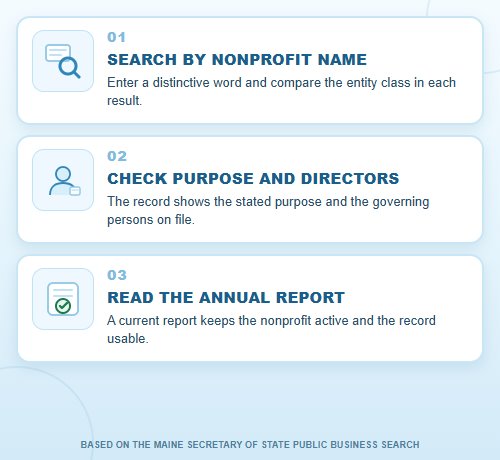
The state search portal is the Interactive Corporate Services system, usually shortened to ICRS. It covers nonprofit corporations, business corporations, LLCs, partnerships, and the foreign entities registered to do business in Maine. No account is required to look up an entity. A visitor types a full or partial name, picks a result from the list, and views a detail page that shows the charter number, filing date, status, and the most recent annual report. The same screens serve attorneys, journalists, and members of the public without any difference in access.
Nonprofit listing:
https://apps3.web.maine.gov/nei-sos-icrs/ICRS
Nonprofit files list directors, not shareholders.
Searches work best with the charter number if you have it, because names change and duplicates are frequent. A church might file as First Baptist Church of a town while the sign outside reads something shorter. A parent-teacher group may appear under an abbreviation. If a name search returns nothing, try the town name alone or the surname of a founder. Filing clerks index what is written on the articles, so unusual spellings, initials, and punctuation can all affect whether a record surfaces on the first attempt.
Searching by Name or Charter Number
The name field accepts partial entries, which is useful when the exact legal name is uncertain. Results arrive as a list rather than a single match, and each row shows enough detail to tell apart entities with similar names. The charter number, sometimes labeled as a filing number, is the most reliable handle. It stays with the entity for life, survives name changes, and appears on the annual report. Write it down once and every later lookup becomes a direct hit. When a name search returns many rows, compare status and formation date before clicking; an active entity formed recently is usually a different organization from a dissolved namesake that filed decades ago under similar wording.
Reading the Entity Detail Screen
A detail screen carries the legal name, the entity type, the jurisdiction of formation, the date the articles were accepted, the current status, and the address of the clerk. For a Maine nonprofit the jurisdiction line reads Maine, while a foreign charity shows its home state. Cross-checking a name against a broader Maine company search often reveals affiliates, predecessors, and dissolved names that a single record hides. Note that the screen lists the mailing address and the clerk separately; the clerk is the person or company that receives legal notices.
What the Articles of Incorporation Reveal
Nonprofit corporations in Maine file under Title 13-B of the state statutes. The articles are a short document compared with the packets some other states require. They name the corporation, state its purposes, list the clerk and the address of the registered office, describe the initial directors, and state whether the corporation will have members. They also include the signature of an incorporator and, for organizations planning to seek federal exemption, optional language from the Internal Revenue Service. The Secretary of State does not evaluate whether the purposes are charitable.
Because the articles are filed on paper, the state’s digital record is a summary rather than a scanned image in every case. Older filings may exist only as an index entry. Requesting a copy of the articles produces a paper document, and the copy is certified on request. Reading the original matters when the exact wording of a purpose clause, a membership provision, or a dissolution clause is in dispute, since the database summary can leave out nuance that the signed document contains.
The Purpose Clause
The purpose clause is the sentence that describes what the corporation intends to do. Maine allows a broad statement such as any lawful purpose permitted to a nonprofit corporation, and many filers use that language to avoid later amendments. A narrow clause naming a specific activity can become a constraint if the organization changes direction. When a grantmaker asks whether a charity’s stated purposes cover a new project, the answer lives in this clause and in any amendments filed since formation.
Membership Provisions
Some nonprofits have members who vote on directors; others have a self-perpetuating board and no members at all. The articles state which model applies. This single choice affects quorum rules, the ability to amend bylaws, and who may call a special meeting. A record showing no members does not mean the organization is closed or private; it means governance rests entirely with the board described in the filings.
Directors, Officers, and the Absence of Shares
A nonprofit corporation issues no shares of stock. The annual report instead identifies the people who run the organization: the president, the treasurer, and other officers, plus the directors serving at the time of filing. This is the closest the state record comes to a governance snapshot. Names change from year to year as boards rotate, so the most recent report reflects current leadership while earlier reports preserve the history of who served when.
Reading several years of reports in sequence can show a stable board, a sudden turnover, or a period when the same few names held every office. That pattern is often more informative than any single filing. Officers listed in an annual report are not necessarily paid, and the record does not distinguish a working board from an honorary one. Nothing in the state file indicates salary, hours, or whether a director also serves as staff.
For anyone comparing a charity with its for-profit neighbors, the structural difference is stark. A business corporation files articles and reports that connect to shareholders, while the nonprofit equivalent connects to directors and members. Searchers who need the business side of the index can consult Maine corporation records for the parallel filing types, fee schedule, and annual report rules that apply to entities with capital stock. The two systems share a portal but not a governance model.
Maine Nonprofit Status Versus Federal 501(c)(3) Exemption
Registration as a Maine nonprofit corporation is a state act. Recognition as a tax-exempt charitable organization under section 501(c)(3) of the Internal Revenue Code is a federal act. Filing articles with the Secretary of State does not confer exemption, and the state does not verify an organization’s federal status when it accepts the articles. A new charity must apply separately to the IRS, usually by submitting Form 1023 or the shorter Form 1023-EZ, and wait for a determination letter.
The two statuses can diverge. An organization may be a valid Maine nonprofit corporation and still lack federal exemption because it never applied, its application failed, or its exemption was revoked. Conversely, a group may hold federal exemption while operating under a fiscal sponsor and never form its own state entity. For due diligence, check both. The IRS maintains a searchable list of exempt organizations, and the state record confirms only the corporate registration.
Maine also recognizes other exempt categories, and the state tax code treats some nonprofits differently from the federal code. Sales tax, property tax, and payroll obligations follow their own rules, administered by Maine Revenue Services rather than the Secretary of State. A clean corporate record says nothing about whether the organization holds a valid exemption certificate or has filed its state returns. Searchers should treat the corporate file as one layer among several.
Charitable Solicitation Registration With the Attorney General
A charity that asks Maine residents for money may need to register with the Charitable Trusts Unit of the Maine Attorney General’s office. This is a separate filing from the corporate registration and serves a different purpose. The corporate file establishes the entity; the solicitation registration authorizes fundraising and requires periodic financial reporting. Many small organizations, including certain religious bodies and entities under a revenue threshold, qualify for exemptions, but the exemption is claimed rather than assumed.
The Attorney General’s records include financial reports that the Secretary of State never collects. That makes the two sources complementary. A searcher who wants to know whether a charity is allowed to solicit and how it spends money should look at both. Confusing the two creates false comfort: a current corporate annual report does not establish that a solicitation registration exists, and a lapse in one file does not automatically mean the other has lapsed.
Annual Report and Certificate of Existence
Every Maine nonprofit corporation files an annual report due June 1. The report updates officers, directors, and the clerk’s address, and it keeps the entity in good standing. It can be filed online, which is a convenience not available for the initial articles. A missed deadline triggers a late penalty and, if ignored long enough, administrative dissolution. Restoring a dissolved charity requires a reinstatement filing and payment of the accumulated charges.
A certificate of existence is the state’s formal statement that an entity is active and current at a given moment. Lenders, grantmakers, and banks often ask for one. It is dated, so a certificate from last year proves only last year’s status. Request a fresh certificate for any transaction that depends on good standing, and check the date on the document before accepting it from a counterparty.
Restoring Good Standing After Dissolution
A charity that ignored several annual reports will eventually be administratively dissolved. The dissolution is a status change, not a court action, and the entity can usually be revived by filing the missing reports, paying the penalties, and submitting a reinstatement application. The record then shows a gap in filing history that never disappears. A grantmaker reviewing that history will want to know why the gap occurred and whether governance changed during the lapse, so keep a written account ready before anyone asks.
Foreign Nonprofits Registered in Maine
A nonprofit formed in another state that conducts substantial activity in Maine must register as a foreign nonprofit corporation. The filing is an application for authority, and it requires a clerk in Maine plus evidence of the home registration. The record then shows two jurisdictions: the state of incorporation and Maine. Enforcement of charitable rules still follows the home state’s charter, but Maine’s annual report and registered office requirements apply to the Maine presence.
Foreign registration is a frequent source of confusion when a national charity’s local chapter appears to be a Maine entity. Sometimes the chapter is a separate Maine corporation with its own board; sometimes it is the national entity registered to do business here. The filing type and the jurisdiction line distinguish the two. The address of the clerk also helps, since a chapter usually lists a local officer while a national registration lists a commercial service.
A registered foreign nonprofit files the same annual report as a domestic one, on the same June 1 schedule, though the charge differs and should be confirmed against the current schedule before a check is mailed. It also keeps a clerk in Maine for the life of the registration. If that clerk resigns, the entity must appoint a replacement promptly; a registration with a stale address can be revoked, and a revoked foreign registration bars the charity from enforcing contracts in Maine courts until it is restored.
What the Public Record Does Not Show
Donors are not listed. The state collects no contributor information and publishes none. A record cannot confirm who funded an organization, how much any donor gave, or whether a major gift carried restrictions. This surprises people who expect charity registries to resemble campaign finance databases. Maine’s corporate file is a registry of legal existence, not a disclosure regime for contributions.
Finances are not part of the corporate file either. Revenue, expenses, assets, and compensation appear, if at all, in federal filings or in the Attorney General’s solicitation reports, not in the Secretary of State’s annual report. Program descriptions are likewise absent. The purpose clause states an intention at formation, not a description of current activities, and a charity may operate well beyond the literal wording as long as the work remains consistent with its chartered purposes.
Nor does the record evaluate quality. Nothing in the file says whether a nonprofit is effective, well governed, or honest. It records that certain papers were filed and certain fees were paid. That limits what any conclusion drawn from the portal can support. A clean record is evidence of compliance with registration duties, and nothing more. Reading it as a rating of the organization’s work overstates what the state actually verifies.
Bylaws and Meeting Minutes
Bylaws are the internal rulebook, and Maine does not require them to be filed with the state. Board minutes are likewise private. A searcher who wants to see quorum rules, conflict of interest policies, or the vote that authorized a major transaction will not find them in the portal. The articles may say that bylaws were adopted, but the document itself stays with the corporation. Requesting bylaws directly from the organization is the only reliable path, and a charity can decline.
This gap is why two organizations with identical portal records can behave very differently. One may hold open meetings and publish minutes; another may conduct everything by private email. The state file cannot distinguish them, because it was never designed to. Governance quality is something a funder or volunteer learns by attending a meeting, reading an audit, or speaking with former directors, not by refreshing a database.
Tracking a Charity Through Name Changes
A nonprofit that rebrands still holds the same charter number. The record shows the current legal name while the filing history shows the earlier ones, but the name search matches what the database holds now, not what the entity called itself a decade ago. Someone looking for an old name may see nothing and conclude the charity no longer exists. Searching the charter number, the town, or a long-serving officer resolves most of those dead ends.
Amendments that change the name or narrow the purposes are filed as separate documents, and a complete history requires ordering them. Each amendment carries its own charge and follows the same paper process as the original articles. When a grant application cites a legal name that no longer matches the portal, ask for the amendment rather than assuming an error. The mismatch is usually a rebrand, a merger, or a move from a project name to a formal one.
Fiscal Sponsorship and Borrowed Exemption
Some charitable projects never incorporate. They operate under the umbrella of an established charity that accepts donations on their behalf, a relationship known as fiscal sponsorship. The state record shows the sponsor, not the project. A donor who searches for the project name finds nothing, and a donor who finds the sponsor may wrongly assume the sponsor runs the project’s programs. Reading the sponsor’s purpose clause rarely clarifies the relationship, because the umbrella predates the project.
Fiscal sponsorship is legitimate and widespread in Maine, particularly for new initiatives that want to test an idea before committing to a board and annual reports. The practical question for a searcher is who controls the money and who is legally accountable. That answer sits in a sponsorship agreement, not in the portal. Treat the corporate record as an identifier for the accountable entity and ask the parties for the agreement when the distinction affects a grant or a contract.
Fees for Nonprofit Filings
Maine publishes a fixed schedule for nonprofit filings. The amounts below cover the documents most often requested by the public and by organizations keeping their records current. Fees are payable to the Secretary of State, and paper filings sent by mail should include the correct amount to avoid a return of the packet.
| Filing | Fee | Notes |
|---|---|---|
| Articles of incorporation | $40.00 | Paper filing, mailed or delivered to the counter |
| Annual report | $35.00 | Due June 1 each year, online filing accepted |
| Late penalty | $25.00 | Added when the annual report arrives after the deadline |
| Certificate of existence | $10.00 | Dated proof of active status for a nonprofit |
Frequently Asked Questions
These questions come up often when someone reads a Maine nonprofit record for the first time.
Does a Maine nonprofit registration make an organization tax exempt?
No. State incorporation and federal exemption are separate. The IRS grants 501(c)(3) status after its own review, and the Maine filing does not substitute for that application.
Can I see a nonprofit’s donors in the state record?
No. Maine does not collect or publish donor information in the corporate file.
Where is the annual report filed?
With the Secretary of State, due June 1, and it can be submitted online.
What does a certificate of existence prove?
That the entity was active and current on the date printed on the certificate.
Do all charities need to register with the Attorney General?
Only those that solicit in Maine and do not qualify for an exemption. Registration is separate from corporate filing.