

An assumed business name is the name a company puts on the door when it differs from the name on its charter. Maine calls the filing an assumed name statement, and it is registered with the Secretary of State by a limited liability company, a corporation, a limited partnership, or a limited liability partnership. The label carries no liability shield and creates no entity; it exists so the public can connect a sign to a registered owner.
Searching one is a two-part exercise. The label sits in its own record, and the owner sits in the entity record beside it, joined by a charter number. This page covers which office holds which name, how long a statement lasts, how renewal and termination work, what a bank wants to see, and where a trademark question begins. Fees for those filings sit in one table near the close.
How to Trace an Assumed Business Name in Maine
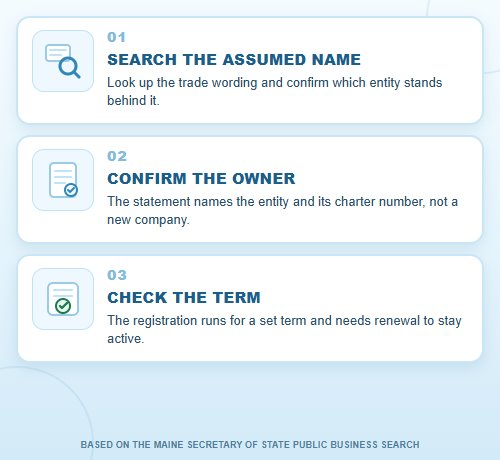
Search the label first, then the owner. The division’s index returns assumed name entries beside entity records, so a single query on the words can produce both a label filed last year and the company that registered it a decade ago. The order matters when the label is generic, because a short phrase can belong to several owners in different trades.
Search the Label as Written
Type the name without the words LLC or Inc., since an assumed name may not carry an entity ending at all. Keep the spelling used on the sign, including an unusual plural or a missing apostrophe. A label that reads like a slogan can return nothing even when it is on file, because the statement records the name as the owner supplied it rather than as the public writes it.
Try the label with and without its leading article. Owners who file The as part of the name create a record that a search on the bare words may not surface, and the comparison rules treat the article as weak. Two versions of one query cost nothing and often produce the entry.
Open the Owner Record Behind It
Each assumed name entry identifies an owner and a charter number. Run that number in the entity search to reach the formation document, the status, the agent, and the report history. The owner may be a company that has since changed its legal name, which is why the number is more reliable than the owner line on the label record.
Check the Filing Date Before You Rely on It
A statement filed years ago may have lapsed, and a lapsed statement leaves the label unprotected even though the words still sit in the index. Read the filing date, add the five-year term, and compare it with today. A record that is past its term tells you the owner once used the name, not that the owner still holds it.
Dates in the index are posting dates rather than signature dates, so a document mailed in March and posted in April carries the April date. The gap rarely matters for a statement, and it matters a great deal when a lease or a loan closed in between. Note both dates when you copy a record for a file.
Assumed names:
https://apps3.web.maine.gov/nei-sos-icrs/ICRS
Statements link a trade name to the charter number.
Who Files With the State and Who Files With the Town
The office that holds a business name depends on the form of the business. Entities registered with the division file their assumed names there. A sole proprietor and a general partnership do not register with the division at all, so their trade names live with the town clerk where the business operates. A search that skips one office can miss the record entirely.
Entities That File at the State Level
A limited liability company, a business corporation, a nonprofit corporation, a limited partnership, and a limited liability partnership all file an assumed name statement with the Secretary of State. The filing names the owner, the charter number, and the words to be used. The state statement is what lets a bank, a vendor, or a customer tie the label to a registered entity.
Trade Names Registered With a Town
A sole proprietor files a trade name certificate with the clerk in the municipality where the business is located. A general partnership does the same. Neither filing produces a charter number, and neither appears in the state index. The clerk’s fee is set locally, the form is short, and the record is kept by the town rather than by Augusta.
Some towns also require a business license or a sign permit, and those approvals are separate from the trade name. A shop that registers the name but skips the license can still be cited. Ask the clerk what else the town requires at the same counter, because the answer varies by municipality and by trade.
Why the Split Catches People
A statewide search can come back clean for a name that a shop has used for twenty years, because the shop never registered with the state. A buyer who relies only on the state index may conclude that a name is free when the town record says otherwise. The Maine company search covers the state side; the town clerk covers the rest, and a serious check uses both.
The split also affects a business that changes form. A sole proprietor who organizes an LLC begins a new filing life at the state level, and the town trade name does not travel with the entity. Register the label again at the state level, then decide whether the town filing should be kept or closed.
The Assumed Name Statement and Its Five-Year Term
An assumed name statement runs for five years from the date the division accepts it. The term is fixed rather than indefinite, and the owner must renew before it ends to keep the label on the register. A statement filed for a business that closes in year two stays on the file until it is terminated or until the term runs out.
What the Statement Contains
The form asks for the assumed name, the owner’s legal name, the charter number, the principal office, and the registered agent. It does not ask for a business purpose or a description of the trade. The owner signs, and the division returns a receipt that shows the filing date. Keep that receipt, because it is the document a bank will ask for when the account name differs from the charter name.
Renewing Before the Term Ends
Renewal is a new filing with the current information, not an automatic rollover. A renewal filed after the term has expired can leave a gap in the record, and a gap is what a careful vendor will notice. Put the expiration date on a calendar with a reminder two months out, and confirm the agent and office at the same time so the renewal is accurate when it lands.
A renewal does not change the label, and a renewal that carries a different owner is a new statement rather than a continuation. Read the form before signing and check that the name matches the sign, the invoice, and the website footer. Three versions of one label across three documents is the kind of detail a lender will ask about.
Changing the Label or the Owner
A new label takes a new statement, and the old one should be terminated so two records do not compete. A change of owner, through a sale of assets or a conversion, also calls for attention, because the statement names a specific entity. Do not assume that a charter number on the label record still points at the business running the counter today.
How an Assumed Name Appears in the State Search
The index lists assumed names as entries of their own, with the label in the name field and the owner in a separate column. The entry can look thinner than an entity record, since it carries no annual report and no formation date of its own. The charter number is the bridge between the two.
Reading the Entry
Expect the assumed name, the owner, the charter number, the filing date, and a status. The status describes the statement rather than the business, so a lapsed statement on an active company is a normal combination. Read the entity record before you draw a conclusion about the business itself.
An entry with no owner listed usually means the statement was filed before the current form was in use or that the label was registered by an individual. In that case the town clerk is the next stop, because an individual who never formed an entity would have filed locally. Do not assume the state record is complete when a field is blank.
Following the Number to the Charter
Enter the charter number in the entity search and read the formation date, the current name, and the agent. If the owner has changed its legal name since the statement was filed, the entity record shows the new name and the amendment that produced it. Two records read in sequence give a cleaner history than either one alone.
When the Label Returns Several Owners
Short labels repeat across trades: a word like coastal or northern can belong to a landscaper, a bakery, and a builder at once. Compare the owner type and the town, then open each entity record until one matches the address in front of you. A label is not exclusive, and the register does not promise that only one business uses it.
Ending an Assumed Name
A statement ends with a termination filing, which takes the label off the register before its term expires. Owners terminate when they rebrand, close, or sell the business, and a termination is also the clean way to clear a label that a successor will not use. The filing is short and names the label and the owner.
Termination Versus Expiration
An expired statement leaves a dated record that reads as abandoned. A terminated statement closes the record on a known date. The difference matters to a buyer doing diligence, because a clean termination shows that the owner made a decision rather than simply stopped paying attention.
What to Do With the Sign and the Accounts
Terminating the filing does not remove the words from a sign, a website, or a bank account. Update the accounts first, then terminate, so the business is not left operating under a label it no longer holds. Keep the termination receipt with the entity records in case a vendor asks why the name changed.
Assumed Names, Brands, and Trademark Rights
Registering an assumed name gives an owner the right to use the label in Maine, and it gives the public a way to find the owner. It does not give the owner exclusive rights to the words. Trademark rights come from use in trade and from registration, and a state assumed name filing is neither.
What the Filing Proves
The statement proves that an owner registered a label on a date and that the label belongs to a registered entity. It does not prove that the label is distinctive, that no one else uses it, or that a competitor must stop. A business that builds a brand on the label should look at the federal register before it prints packaging. The Maine name records page sets out how the underlying legal name is read.
An assumed name can also be a liability when it sits too close to a larger brand. A letter from a national company is expensive to answer even when the local business is right. A search of the federal register and a search of the open web take an afternoon, and they reduce the chance that a sign becomes a legal problem.
Two Owners, One Label
Maine does not reserve a label statewide for one trade the way it reserves a legal name. Two entities in unrelated lines can file the same assumed name, and the division may accept both. The conflict, if there is one, is settled by trademark law or by a contract rather than by the filing office. That is the reason a clearance search belongs before a launch, not after a demand letter.
What a Bank Asks For
Banks open accounts in the legal name of the entity, and a trade name is handled as a second name on the same account. The file usually needs the formation document, the assumed name statement, the employer identification number, and the operating agreement or bylaws. The statement is what connects the sign to the charter.
The Documents in the File
Bring the certificate from the division, the receipt for the assumed name statement, and a current annual report. The certificate shows the legal name and the charter number, the statement shows the label, and the report shows that the entity is in good standing. A bank that sees all three can match the account, the sign, and the state record without a research project.
Call the branch before the appointment and ask what the account opening file requires, because institutions differ on the order of documents. Some want the statement certified, some accept the receipt, and some ask for the operating agreement as well. A five-minute call saves a second trip with a signature card that has to be signed again.
When the Names Do Not Match
A check made out to the label can be deposited into an account held by the entity, but the bank may ask for the statement before it accepts the item. A lease signed under the label can create the same question. Keep a copy of the statement in the account file and give one to the bookkeeper, so the mismatch is documented before it becomes a hold on a deposit.
Accounts That Need the Same Update
The tax account, the insurance policy, the card processor, and the online marketplace seller profile all carry a name. None of them update because a statement was filed. Work through the list once a year, compare each record with the charter name and the label, and correct the ones that drifted.
Copies, Certificates, and Proof of Filing
A screenshot of a search result is not a certified record. The division issues certified copies of filed documents for a charge, and a certified copy is what a bank, a title company, or a court will accept. Order one when the label matters to a transaction rather than to an internal check.
What a Certified Copy Shows
The copy carries the division’s certification and the date the document was filed. It does not add facts that were never filed, and it does not prove that the statement is still in force. Pair it with a current search result when standing matters, and note the date of the search on the copy.
Order the copy by mail or at the counter and state the exact name and charter number. A request that names only the label can pull the wrong record when several owners use the same words. Pay the page charge with the order so the request is not held, and keep the receipt with the copy when it arrives.
Ordering Records for a Closing
A buyer assembling a file should order the assumed name statement, the certificate of formation, and the most recent annual report together. Read the dates in order and check that the owner on the statement matches the seller on the purchase agreement. A mismatch is a question for the closing, and it is easier to answer before the money moves.
Add the termination receipt when the seller has stopped using an old label, and add the new statement when a successor has already filed one. The set should tell a single story from formation to the present. A file with missing pieces is not necessarily a problem, but it is a reason to ask a question in writing rather than at the table.
Charges for Assumed Name Filings
The four figures below cover the assumed name work described above. Each is set by statute, and money paid for a refused filing stays with the state.
| Filing | Fee | Notes |
|---|---|---|
| Assumed name statement | $125.00 | LLC, corporation, LP or LLP |
| Assumed name statement, nonprofit | $25.00 | Nonprofit corporation rate |
| Termination of assumed name | $20.00 | Reduced rate for nonprofits |
| Certified copy | $5.00 | Plus $2.00 per page |
Frequently Asked Questions
These questions come from owners who use a trading name and from buyers checking one before a closing.
Does an assumed name create a separate company?
No. The statement registers a label for an existing owner, and the entity, the charter number, and the liability protection all stay with the legal name on the formation document.
How long does a Maine assumed name last?
Five years from the filing date. The owner renews before the term ends, and a statement that lapses can leave the label without a current record until a new filing is accepted.
Can a sole proprietor file an assumed name with the state?
No. A sole proprietor registers a trade name with the town clerk where the business operates, and a general partnership does the same. The state statement is for entities registered with the division.
Does an assumed name protect a brand name?
It does not. The filing identifies the owner of the label and gives no exclusive right to the words. Trademark protection depends on use in trade and on registration, which is a separate question.
What does a bank need for an account under a trading name?
The formation certificate, the assumed name statement receipt, the employer identification number, and a current annual report. Together they tie the label to the entity that will hold the account.