

A Maine business record is a file, not a single page. The public summary gives the name, the charter number, the dates, and the current standing, while the documents behind it carry the signatures, the amendments, the mergers, and the reports that built the entity year by year. Buyers, lenders, and lawyers usually need the file rather than the summary, because the summary states a conclusion and the documents show how it was reached.
This page covers the document side of the register: how to read a filing history, which document types the division holds, how to order copies by mail or at the counter, what certification adds, how retention works, and how to assemble a clean file for a closing. It is about paper and images rather than about whether a company is active. Copy and certification rates sit in the table.
How to Find Maine Company Filings
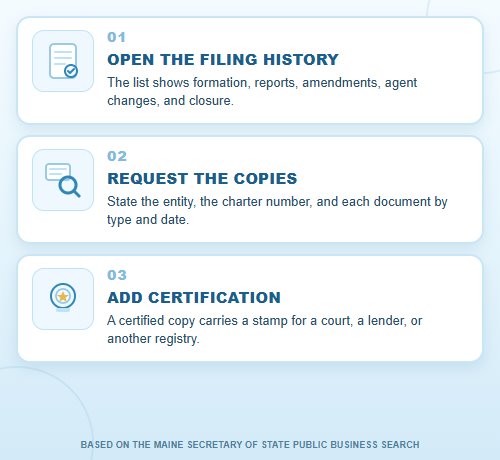
The corporate search returns an entity record with a filing history beneath the summary. That history is the index to the file, and each line names a document type and a date. A reader who wants a copy starts there, notes the document and the date, and then requests the image from the division. The search itself is free and public, and the copies are ordered separately.
Start With the Entity Record
Open the record by name or charter number, and confirm the filing type before going further. A corporation, an LLC, and a nonprofit keep different documents, so the history of one will not look like the history of another. A reader who has only a trade name can begin with a Maine company search and use the result list to find the charter number before opening anything. Confirm the town and the formation date as well, because a similar name in another county is a different file with a different history.
Read the Filing History
The history runs in date order and lists the certificate, each annual report, each amendment, any agent change, any merger, and any dissolution. Read it as a sequence rather than a list: a gap in the report series marks a delinquency, and a second formation entry after a gap marks a reinstatement. Two documents dated the same day usually belong to one transaction.
Where the history shows a name change, the earlier documents sit under the former name and the charter number ties them together. Keep the charter number in front of you while reading, because a search on the old name alone will return only the documents filed before the change. The history is the one place where both names appear side by side.
Note the Document Dates
Each line carries a date, and that date is when the division posted the filing rather than when the company signed it. The difference can be a week or more, and it matters when a contract turns on whether a document existed on a given day. Write the posting date down beside the document name so the file you build later can be checked against the record.
Documents:
https://apps3.web.maine.gov/nei-sos-icrs/ICRS
Copies come from the division that holds the file.
Distinguish the History From the Summary
The summary states the current position and changes whenever a new filing posts. The history is cumulative and does not shrink. A reader who needs to know what a company looked like on a past date works from the history and the posted dates, because the summary only describes the present.
Types of Documents in a Maine File
A Maine entity file is built from a small number of document families, and each family answers a different question. The formation document establishes existence, the amendments change terms, the reports keep the registration alive, the merger documents combine entities, and the dissolution documents end one. A reader who can place a document in its family can tell what it proves.
Formation Documents
The certificate of formation for an LLC, the articles of incorporation for a corporation, and the registration statement for a foreign entity are the founding documents. They carry the original name, the agent, the office, and the incorporator or organizer signature. For a corporation the articles also state the share structure, which is the part a buyer reads when equity is at issue.
Amendments
An amendment changes a term in the formation document: the name, the share count, the management structure, or the duration. Each amendment is a separate filing with its own date, and a company that has amended several times will show a stack of them. Read them in order, because a later amendment can undo an earlier one and the summary shows only the final result.
Annual Reports
Each year produces a report that confirms the agent, the office, and the principal address. The reports are short and repetitive, and their value in a file is the pattern: a missing year, a late posting, or a sudden change of address. A run of reports signed by the same person is evidence of continuity, though not proof of ownership.
Mergers and Conversions
A merger files articles of merger that name the surviving entity and the entities that disappear. A conversion files articles of conversion that change the entity type, such as an LLC becoming a corporation. Both touch more than one record, and both can post at different times, so a file assembled on the merger date may be incomplete. Order the documents for every entity in the transaction.
Agent and Office Filings
A change of agent, clerk, or registered office is a short filing that names the old contact and the new one. It is worth ordering when a dispute or a closing depends on who was reachable on a past date, because the history shows the change and the document shows the consent signature. The filing is easy to overlook and it is often the missing piece in a service question.
Dissolution and Withdrawal
Articles of dissolution end a domestic entity, and an application for withdrawal ends a foreign entity’s authority in Maine. Both are short, and both usually state that debts are provided for. A file that jumps from active reports to a closure with no dissolution document in between points to an administrative action rather than a voluntary one.
Assumed Name Filings
An assumed name is a separate registration that lets a business trade under a second name, and it appears in its own file rather than in the entity history. Order it when the company operates under a name that differs from its legal name, because a contract signed under the assumed name needs the registration behind it. The assumed name file does not create an entity and does not appear on the certificate of existence.
Requesting Copies From the Division
Copies come from the Division of Corporations, UCC and Commissions, and the request can be made at the counter in Augusta or by mail. The division does not post every document image in the free search, so a request is often the only route to the signed page. Plan the request around the document dates in the history rather than around the company name alone.
Counter Requests
A counter request is the fastest route when the office is open and the file is small. Bring the entity name, the charter number, and the document dates, and expect to pay per page. The clerk can confirm whether a document exists before the copies are run, which saves a wasted order when a history line turns out to be a notation rather than a filing.
Mail Requests
A mail request needs a cover letter, a check or money order, and a self-addressed envelope when paper copies are wanted. State the entity, the charter number, and each document by type and date, and ask for the page count if the cost is capped by a budget. Mail adds transit time on both ends, so a closing file should be ordered well before the signing date.
What to Include in a Request
The request should name the entity exactly as it appears on the record, give the charter number, list the documents in date order, and state whether plain or certified copies are wanted. Add a daytime contact and an email address for questions. An ambiguous request comes back with a question instead of a file, which costs a week.
Requests From Outside Maine
A requester outside the state works by mail or through a courier, and the division answers in the order it receives. Pay with a check drawn on a United States bank or a money order, and add a phone number where a question can reach you. A foreign buyer should allow extra time for postage and should order the certificate of existence close to the closing date so it does not age in transit.
Plain Copies and Certified Copies
A plain copy is an image of the document with no seal and no signature page from the division. A certified copy carries the division’s attestation that the image matches the file, and it is what a third party accepts when the document has to be relied on. The difference is not the paper; it is the signature and the seal.
What Certification Adds
Certification adds a statement by the division that the copy is true to the record, signed and sealed on a stated date. That statement is what makes the copy usable outside the room where it was printed. A bank, a title company, a court, and a foreign registry usually ask for it, and a plain copy will be refused even when the text is identical.
When a Certified Copy Is Needed
Certify a document when it will be recorded, filed with a court, presented to a lender, or used to prove authority in another state. Keep plain copies for internal work and for the file index. A certified copy of an older amendment is often enough to show a name change, while a certified copy of the current formation document is what a closing agent wants.
Order certification at the same time as the copy rather than afterward. A second request means a second handling charge and a second wait, and the division cannot certify an image it has already sent without pulling the file again.
Turnaround and Expedited Handling
Standard processing of a filing or a copy request runs several business days, and the record or the image posts after the work is done. Volume rises at the end of the report season, when the division handles a year of reports in a few weeks. A request that would take three days in February can take longer in June.
Standard Processing
A standard request is the default and the cheapest. It fits a file that is being built for the record rather than for a deadline. Track the request by the date it was received, not the date it was mailed, and follow up with the division only after the posted window has passed. A duplicate request slows the original.
Next-Day and Same-Day Requests
Expedited service moves a submission to the front of the queue, with a next-business-day option and a same-day option. The charge is separate from the filing fee and is collected per submission. It is worth paying when a closing, a court date, or a contract deadline depends on the document, and it is wasted when the file can wait a week.
Expedited handling does not change what the document says and does not create a document that was never filed. It only shortens the wait for a document that already exists in the file. A document the division never received cannot be produced, no matter how fast the request is handled.
Retention and Missing Documents
Maine keeps entity files for the life of the entity and beyond, but the file is not complete in every case. Older records were kept on paper and microfilm, some were thinned under earlier retention schedules, and some documents were filed under a name the company no longer uses. A gap in a file is a fact about the record, not proof that a filing never happened.
What Maine Keeps
The division holds the formation document, the amendments, the annual reports, the agent filings, the merger and conversion documents, and the dissolution or withdrawal. It also holds the correspondence attached to a rejected or corrected filing in some cases. It does not hold operating agreements, bylaws, minutes, stock ledgers, or tax returns, because those are not filed with the state.
Why Old Files Have Gaps
A company formed decades ago may show a formation document and a run of reports with a missing middle. The paper may have been archived, the name may have changed twice, or the report may have been filed on a form that was indexed under a different label. Ask the division to search by charter number before concluding that a document does not exist.
A reinstatement often fills a gap that looks like a missing year. The cure reports are filed together, and the history shows them as a cluster rather than as a sequence. Read the cluster before you describe the company as having stopped filing, because the record may show a cure rather than a lapse.
Building a Document File for a Closing
A closing file is a set of documents that answers the questions a buyer, a lender, and a title company will ask. The state record supplies the corporate half, and the company supplies the governance half. Build the state half from the history, and mark each item with the date it was obtained so the file can be refreshed if the closing slips.
The Core Set
Start with the current formation document, every amendment, the last two annual reports, and the certificate of existence. Add the agent filing if the agent changed within the year, and add the merger documents if the entity was formed through a combination. The core set is what proves the entity exists, what its current terms are, and that it is current with the state.
The Supplemental Set
Add the dissolution documents for any predecessor, the withdrawal for any foreign registration that ended, and the assumed name filings if the business trades under a second name. A lender will also want the operating agreement or the bylaws, the resolutions approving the transaction, and a certificate from the home state of any foreign entity in the chain.
Dating and Indexing
Give every item a date of retrieval and a source line, and number the pages in one sequence. A file that mixes copies from three months apart without dates invites a question about which version controls. Refresh the certificate of existence close to signing, because it is the one item that describes the company on a single day.
Keep a copy of the request letters and the receipts with the file. They show what was ordered, what was paid, and what came back, which is useful when a document is missing and the other side asks why. The Maine certificate of existence page covers the one document in the set that carries a date and a seal.
Refreshing a File Before Signing
A file built a month before a closing describes a company a month old. Pull the history again on the morning of signing, compare it with the copy in the binder, and replace any document that changed. Order a fresh certificate of existence rather than reusing the earlier one, and note the new date on the index so the other side can see which version controls.
Maine Record and Copy Fees
The charges below cover copies, certification, the standing certificate, and expedited handling. Maine sets them by statute, and the division collects them when the request is submitted. An underpaid request comes back, and a document the division never held is answered without refunding the search time.
| Filing | Fee | Notes |
|---|---|---|
| Copies | $2.00 | Per page |
| Certification | $5.00 | Per copy certified |
| Certificate of existence | $30.00 | Per certificate |
| Expedited service | $50.00 | Next business day |
A long document costs more than a short one, because the page charge applies to each sheet in the image. Confirm the sheet count before a large order, and consider whether a certified copy of the first and last pages will do instead of the whole document. Keep the receipt with the copies, because it shows what was ordered, what was paid, and how many pages were supplied, which settles a question about an incomplete file without a second request.
Frequently Asked Questions
These questions come from readers ordering copies for a closing, a loan, or a court file. Each answer points to the office or the document behind it.
Can I get Maine company documents online?
The free search shows the filing history and the summary. Document images are ordered from the division by mail or at the counter, and certified copies are issued on request.
How much does a copy of a Maine filing cost?
The page charge applies to each page of the copy, and certification is a separate charge per copy. The table above lists both, along with the standing certificate and expedited handling.
What is the difference between a copy and a certified copy?
A plain copy is an image of the document. A certified copy carries the division’s signed and sealed statement that the image matches the file, which is what a bank, a court, or a title company will accept.
Does Maine keep operating agreements or bylaws?
No. Those documents are not filed with the state and do not appear in the entity file. Ask the company for them, along with the minutes and the resolutions that authorize a transaction.
How long does a copy request take?
A copy request waits in the queue after it arrives. A rush request shortens that wait to one day, or to the same day when the office can fit it in.