

A Maine certificate of existence is a short official statement that an entity is registered with the Secretary of State and stands in the position the record describes on the day the certificate is signed. It is not a copy of the file and not a summary of the filing history. It is a dated conclusion, sealed by the Division of Corporations, UCC and Commissions, and it is the document a bank, a buyer, or another state’s registry asks for when it wants proof that a company is real.
This guide covers the certificate as a document: the facts it recites, the route to order one by mail or at the counter, the difference between a certificate and a certified copy, the related certificate of fact and certificate of authority, the way a recipient reads the issue date, and the limits of what the paper proves. Certificate and copy charges are in the table below.
How to Request a Maine Certificate of Existence
The request goes to the Division of Corporations, UCC and Commissions, and it can be made by mail or in person at the counter in Augusta. The free public search shows the entity record, but it does not produce the certificate. The certificate is a separate document prepared by the division, signed and sealed, and issued for a stated entity on a stated date.
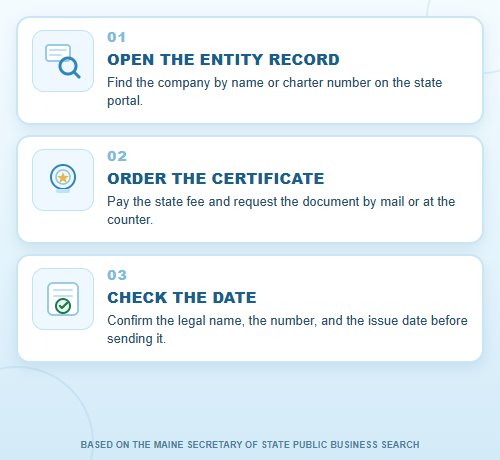
Identify the Entity on the Record
Start with the exact legal name and the charter number. A trade name, a former name, or a shortened name will send the request to the wrong file or back with a question. Use a Maine company search to pull the record, then copy the name and charter number exactly as they appear. Check the entity type as well, because a corporation and an LLC with similar names are different files.
Choose the Document That Fits the Purpose
A domestic entity usually asks for a certificate of existence, while a foreign entity registered in Maine may be asked for a certificate of authority. A party that needs one specific fact, such as a merger or a name change, may be better served by a certificate of fact. State the purpose in the cover letter when the request is unusual, because the division can then confirm whether the certificate you named is the one that answers the question.
Order at the Counter
A counter request lets the requester confirm the name and the entity type with a clerk before anything is issued. Bring the charter number, the entity name, the document wanted, and a method of payment. A certificate for a clean record can often be prepared while the requester waits, though a busy week or an unusual request may push the work to the next business day. Ask at the window before assuming same-visit delivery.
Order by Mail
A mail request needs a cover letter, the exact entity name, the charter number, the entity type, the document wanted, and a return address. Add a check or money order for the correct amount and a self-addressed stamped envelope if paper is wanted back. Say whether the certificate is for a closing, a loan, or a foreign filing, and give a daytime phone number or email so a question can be resolved without returning the whole packet.
Certificates:
https://apps3.web.maine.gov/nei-sos-icrs/ICRS
Certificates carry the issue date on their face.
Pay the Certificate Charge
The charge depends on whether the entity is a business entity or a nonprofit corporation, and it is collected when the request is submitted. A request that under pays is returned, which adds a round trip to the timeline. A request that over pays is not a faster request; it is a payment that has to be reconciled. Confirm the current amount on the division site before writing the check, and keep the receipt with the certificate.
Allow for Processing and Delivery
A certificate is not issued at the moment the search results appear. Standard handling adds business days, and mail adds transit at both ends. A closing that needs the paper in hand should order two weeks before the signing date, not two days. When the date is tight, ask about expedited handling at the counter or in the cover letter, and treat the certificate as a document with a production schedule rather than as a printout.
Order more than one original when two parties will each keep a copy. A bank may retain the certificate it receives, and the company’s own closing binder will look incomplete without one. A scan is useful for the working file, but a scan does not carry the raised seal, and a recipient that inspects the paper will notice the difference. Two originals cost less than a second request made under deadline pressure.
What the Certificate States
The certificate is deliberately short. It names the entity, gives the charter number and the entity type, recites the formation or registration date, states the position of the entity on the record, and carries the date of issue with the division’s signature and seal. It does not narrate the company’s history, list its officers, or describe its business. A reader who wants those details works from the record and the filed documents.
Name, Charter Number, and Entity Type
The legal name on the certificate is the name on the record at the moment of issue. If the company changed its name and filed the amendment, the certificate shows the new name, and the old name sits in the history rather than on the certificate. The charter number is the permanent identifier that ties the certificate to the file, and the entity type tells the reader which body of law governs the entity.
Formation Date and Home Jurisdiction
For a domestic entity, the certificate recites the date the formation document was filed in Maine. For a foreign entity, it recites the home jurisdiction and the date authority was granted in Maine. The distinction matters to a recipient that is checking which state chartered the company. A Maine certificate for a foreign entity proves Maine authority, not Maine incorporation, and a careful reader will notice the difference.
The Standing Statement
The standing statement is a conclusion drawn from the record on the issue date. It tells the reader whether the entity exists and whether the division’s filings are current. The wording is not a guarantee about the future and not an audit of the company’s operations. It reflects the state’s own register, which is why a certificate can be accurate about existence and silent about everything a business partner might want to know.
The exact wording varies with the document requested and with the entity type. Read the sentence rather than the heading, and note the date beside it. If the recipient’s checklist uses a phrase the certificate does not use, send the checklist to the division with the request so the wording can be confirmed before the document is issued. A certificate that answers a different question than the reviewer asked will be returned even when its seal is genuine.
The Issue Date and the Seal
The issue date is the hinge of the whole document. Every fact on the page is true as of that date, and the seal and signature are what make the page an official statement rather than a screenshot. A certificate without a visible date or seal should be questioned. A photocopy of a certificate is a copy of an official statement, not the statement itself, and many recipients will ask for the original or a certified version.
Check the certificate against the search result before filing it away. The legal name should match character for character, including punctuation and the designator at the end. The charter number should match the record, and the issue date should be a date the recipient will accept. A misspelled name is rare but it happens when the request was typed from an old contract, and a bank will reject a certificate that names a different entity.
Certificate, Certified Copy, and Certificate of Fact
Four documents come out of the same office and are often confused. The certificate of existence describes the entity’s position, the certificate of authority describes a foreign entity’s permission to do business in Maine, the certificate of fact recites a particular item from the record, and a certified copy reproduces a filed document with an attestation. The right choice depends on what the recipient needs to see.
The Certificate of Existence
The certificate of existence is the general-purpose standing document. It answers whether the entity is registered and current, and it is what a bank asks for when it opens an account or renews a credit line. It is issued for a domestic entity and for a foreign entity that wants to show its Maine registration. It does not reproduce the formation document and does not list owners.
The Certified Copy
A certified copy is an image of a specific filed document, such as the articles of incorporation, an amendment, or an annual report, with the division’s statement that the image matches the file. It proves what the document says, which is a different question from whether the entity is current. A closing file often needs both: the certificate for status and certified copies for the terms that govern the entity.
The Certificate of Fact
A certificate of fact recites one item from the record rather than the overall position of the entity. It can be useful when a recipient needs confirmation of a single event and does not want a full status document. Because the wording is specific, the request should describe the fact plainly and include the document date if one is known. The division can confirm whether the fact is one it certifies before the request is processed.
The Certificate of Authority
A certificate of authority is the document a foreign entity obtains when it registers to do business in Maine, and a later certificate can confirm that the authority is in effect. It is not the same as a certificate of existence from the home state. A lender reviewing a foreign borrower usually wants both: the home state certificate for existence and the Maine certificate for authority.
Choosing Between Them
A closing that turns on status and terms usually needs a certificate of existence plus certified copies of the formation document and the last amendment. A registration in another state may need only the certificate, or it may need a certificate of authority if the entity is foreign to Maine. A request for one specific event calls for a certificate of fact. Match the document to the question the recipient has asked, and order the set in one request.
How a Bank or Buyer Uses the Issue Date
A certificate describes a single day, and institutions build their rules around that limit. A bank may require a certificate dated within a set window before it releases funds, and a buyer may require one dated after the last amendment or report. The date is not a formality; it tells the reader how stale the conclusion is. A certificate from last year is a statement about last year.
Closing Files and Credit Files
A closing agent typically places the certificate near the front of the binder, ahead of the formation documents and the resolutions. A credit file does the same, often with a checklist that names the acceptable age of the certificate. Ask the recipient what date range it accepts before ordering, because a certificate that arrives one day outside the window is treated as no certificate at all by a strict reviewer.
Refresh Windows
A refresh window is the period a recipient will accept, and it is set by the recipient rather than by Maine law. Thirty days is a frequent figure, and some institutions accept sixty while others insist on ten. Order the certificate close to the date it will be reviewed, and keep the receipt so the ordering date can be shown if the review slips. A second certificate is cheaper than a delayed closing.
When the Date Is Older Than the Deal
A deal that slips by a month can outlive its certificate. When that happens, order a new one rather than annotating the old one. The record may have changed in ways the parties did not expect: a report may have lapsed, an agent may have resigned, or an amendment may have posted. The fresh certificate either confirms the earlier position or reveals the change while there is still time to address it.
The Date in a Public Filing
When a certificate is attached to a document that will be recorded, the recording office may note the issue date and compare it with the recording date. A certificate that is several months old can trigger a request for a fresh one even when nothing about the entity has changed. If the filing will sit in a queue before it is reviewed, add that queue time to the age calculation and order later rather than earlier.
Use Outside Maine
A registry in another state or country may accept the Maine certificate as issued, or it may ask for further authentication of the signature and seal. That additional authentication is arranged separately and adds time, so a cross-border filing should start earlier than a domestic one. The certificate remains a Maine document; authentication does not change its contents, only the chain of assurances attached to it.
What the Certificate Does Not Prove
The certificate is often read as a character reference, and that reading is too generous. It speaks to registration and filing position, not to solvency, honesty, or the quality of the business. A company can hold a clean certificate and still be insolvent, uninsured, or barred from the work it is hired to do. A reader who needs those answers has to look elsewhere.
Ownership and Membership
Maine does not publish member or shareholder lists, and the certificate does not name an owner. A certificate that lists a manager or a registered agent is not identifying the people who hold the equity. A buyer who needs the ownership chain should ask the company for its operating agreement, its stock ledger, and the assignments behind them, and should treat the state record as the starting point rather than the answer. The Maine business records page covers the documents that sit behind the summary.
Tax Standing
The certificate comes from the Division of Corporations, UCC and Commissions, not from Maine Revenue Services. It does not state that taxes are paid, that a return is current, or that no lien exists. A tax clearance is a separate document from a separate agency, and a lender that needs one will ask for it by name. Do not offer a certificate of existence as a substitute in a tax discussion.
Licensure and Permits
Professional and occupational licenses come from licensing boards, and general business permits come from state and municipal agencies. The certificate says nothing about either. A contractor can be registered with the division and unlicensed for the work, and a restaurant can be in good standing while its health permit is suspended. Verify the license with the board that issues it.
Authority of the Signer
The certificate does not prove that the person signing a contract for the company has board approval or written authority. It proves the entity exists. The authority question is answered by resolutions, an operating agreement, bylaws, or a secretary’s certificate. A counterparty that relies on the certificate alone has confirmed the company is real, not that the individual can bind it.
Certificate and Copy Fees
The charges below cover the standing certificate, the nonprofit rate, certification, and page copies. The division sets them by statute, and a request is priced by the document and the page count rather than by the size of the file. A certified copy of a long document costs more than a certified copy of a short one, because the page charge applies to every sheet.
| Filing | Fee | Notes |
|---|---|---|
| Certificate of existence | $30.00 | Business entities |
| Nonprofit certificate | $10.00 | Nonprofit corporations |
| Certified copy | $5.00 | Certification charge per copy, plus pages |
| Copies | $2.00 | Per page |
A certified copy of a ten-page document carries the certification charge and a page charge for each sheet, so the total can exceed the cost of the certificate itself. Ask for the page count before a large order is run, and decide whether the recipient needs the whole document or only the pages that carry the terms. A certificate of existence does not carry a page charge because it is issued as a single short document.
Frequently Asked Questions
These questions come from readers who are ordering a certificate for a closing, a loan, or a registration in another state. Each answer points to the document, the office, or the date that controls.
What is a Maine certificate of existence?
It is a sealed statement from the Division of Corporations, UCC and Commissions that names an entity and describes its registration and filing position on the issue date. It is not a copy of the formation document and does not list owners. A bank, a buyer, or another registry uses it to confirm that the entity is registered and current on that date.
How much does a Maine certificate of existence cost?
The rate is set by entity class rather than by the size of the request. The table above lists the certificate, the nonprofit rate, certification, and the per-page charge for copies.
Can a certificate of existence be ordered online?
The free search is online, but the certificate is ordered by mail or at the counter in Augusta. A request without payment or a return address is held rather than processed.
How long is a Maine certificate of existence valid?
Maine does not set an expiry on the document. The recipient sets the window, and many banks and closing agents ask for a certificate dated within thirty days. Order close to the review date and refresh if the deal slips.
Does the certificate prove who owns the company?
No. Equity records stay with the company. Request the operating agreement, the stock ledger, and the assignments when ownership is the question.