

Every out-of-state company that does business in Maine leaves a second registration behind. Its home state charter proves the entity exists; the Maine filing proves it is allowed to operate here. That distinction matters because the two records answer different questions, and a vendor who checks only the home state can miss a revoked Maine authority, a stale agent, or a name it is not permitted to use in this state. Reading the foreign record correctly takes a few minutes once you know which fields to trust.
The portal groups domestic and foreign entities in one index, which is convenient but easy to misread. A foreign record carries a jurisdiction line that names another state, a qualification date that differs from the formation date, and an annual report obligation tied to Maine rather than to the place of incorporation. Someone who assumes the formation date equals the Maine start date will misjudge how long the company has actually operated in the state, sometimes by decades.
How to Check a Foreign Entity Registered in Maine
Start with the Interactive Corporate Services system run by the Secretary of State. Type the company name into the entity search and look for a result whose jurisdiction is not Maine. The detail page will show the home state, the type of entity, the date Maine accepted the qualification, the registered agent, and the status of the most recent annual report. No account is needed, and the view is the same one state staff use when answering a phone inquiry about a company’s standing.
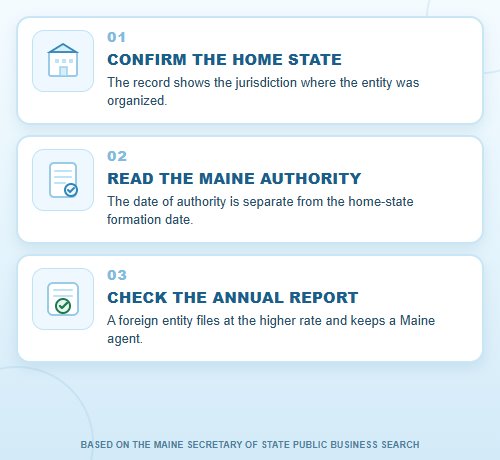
Foreign register:
https://apps3.web.maine.gov/nei-sos-icrs/ICRS
Authority sits apart from the home-state charter.
Companies often register under a legal name that differs from the brand on the door. A national retailer may qualify as an holding company with a numeric suffix, while the storefront uses a short trade name. Searching the brand can return nothing at all. Try the corporate parent, a distinctive word from the signage, or the address of the location. If the Maine operation is a franchise rather than a company store, the local entity may be a domestic LLC entirely unrelated to the brand.
Once you find the record, note its Maine charter number. That number is assigned when the state accepts the qualification, and it is not the same as the home state file number. Keeping both is useful when ordering copies or corresponding with the division, because staff can retrieve a file from either the Maine number or the corporate name. The two numbers also make it clear that a single company carries parallel registrations in different states, each with its own filing history and its own deadlines.
Searching the Foreign Index
Partial names work, and the result list displays the jurisdiction for each row, which lets you filter visually. A company that operates in several states may appear in Maine under a name identical to its home registration, so a name match plus a foreign jurisdiction confirms you have the right record. Where two results look alike, compare the qualification dates and the agent addresses. A recently qualified entity with a commercial agent is usually the operating subsidiary, while an older record may belong to a predecessor that withdrew.
Reading the Jurisdiction Field
The jurisdiction field is the single most important item on a foreign page. It tells you where the entity was formed and therefore which state’s law governs its internal affairs. Maine does not review the home charter, the bylaws, or the ownership structure when it accepts a qualification. Searchers who want to see the complete picture typically pair this record with a Maine company search for local affiliates and then pull the home state file separately, since neither state holds the whole story alone.
Statements of Foreign Qualification for LLCs
An out-of-state LLC that transacts business in Maine files a statement of foreign qualification. The statement identifies the LLC name, the home jurisdiction, the registered agent and office in Maine, and the date the home formation took effect. It is signed by an authorized person and accompanied by the filing charge. Once accepted, the LLC may operate in Maine and must file an annual report each year. The registration does not create a new company; it extends an existing one into the state.
The phrase transacting business is broader than having a website or a bank account, and narrower than employing a sales force. Maine statutes list activities that do not require qualification, and the line between them is a frequent subject of advice from counsel. A company that skipped qualification and later needs to sue in Maine courts may face a delay while it registers. The filing is inexpensive compared with the cost of stalled litigation, which is why most established operators qualify early.
What the Statement Requires
The form asks for the legal name, any assumed or fictitious name used in Maine, the jurisdiction of organization, the principal office address, the registered agent’s name and consent, and a signature. A certificate of good standing from the home state is generally requested with the filing, and its date should be recent. Attach a name reservation or consent if the LLC name conflicts with an existing Maine entity. The state returns defective filings with a note rather than rejecting them silently, so keep a copy of everything sent.
Applications for Authority From Corporations
A business corporation formed elsewhere files an application for authority rather than a statement. The document asks for similar information but adds corporate specifics: the date of incorporation, the period of duration if limited, and the names of its officers and directors as required by the form. The filing charge matches the LLC amount, and the annual report obligation follows the same June schedule. Nonprofit corporations use a separate application with its own lower charge.
The corporate application reveals a governance layer that an LLC filing does not. Officers and directors appear on the application, which gives a searcher named individuals to contact and a sense of who runs the parent. Those names may be stale within a year, since Maine does not require a fresh listing until the annual report. Treat the list as a starting point for the home state record, where amendments and current officer filings are more likely to be current.
Some corporations qualify because a single contract requires it, and withdraw once the project ends. Others maintain an office, payroll, and property. The length of time between qualification and the most recent annual report hints at which category applies, though it cannot prove it. A long unbroken run of reports suggests a real presence. A qualification followed by an immediate withdrawal suggests a transaction-specific registration that has already served its purpose.
The Registered Agent Requirement
Maine requires every foreign entity to keep a registered agent with a physical address in the state. The agent receives service of process, tax notices, and official correspondence. A post office box alone will not satisfy the requirement, and the agent must sign a consent that is filed with the state. Many foreign companies appoint a commercial registered agent service rather than an employee, because the service remains stable when staff turn over and can forward documents the same day.
The agent’s name and address are public, and they are the correct destination for a lawsuit. Sending process to the home office or to a local branch does not satisfy the statute if the agent is listed separately. When a company changes agents, it files a change of agent or an amendment. If the agent resigns without a replacement, the entity can be revoked after a notice period. A record showing a resigned agent is a warning that the company’s Maine authority is on a path to lapse.
Fictitious Names and Conflicts With Local Businesses
A foreign entity may not use a name in Maine that another registered entity already holds. When the real name is unavailable, the company can file a fictitious name and operate under a substitute. The fictitious name is recorded on the Maine file, and the home state name remains the legal identity. Customers may never see the home name, which is why a search on the trade name alone can fail while the corporate name succeeds.
Name conflicts also arise when an out-of-state company expands into a market where a local business owns the name. Registration is not a trademark, and the Secretary of State does not adjudicate infringement. A company with a Maine registration can still be sued by a local user with priority under trademark law. Searchers evaluating a brand should check the state business index, the federal trademark register, and the domain record, since none of the three captures the others.
Annual Reports for Foreign Entities
Foreign entities file an annual report just as domestic ones do, due June 1. The report updates the registered agent, the principal office, and the names of managers or officers. It also carries a higher charge than the domestic rate, reflecting the additional review the state performs. Filing online is available and produces an immediate acknowledgment. The report is the main recurring contact most foreign companies have with Maine, and missing it is the most frequent cause of revocation.
Because the entity’s home state may have a different fiscal year and a different report schedule, compliance calendars often collide. A company incorporated in Delaware with a March anniversary still faces Maine’s June deadline. Building the Maine date into the corporate calendar avoids the scramble that follows a revocation notice. Large companies that operate in many states sometimes delegate the calendar to a service, and the state record is the only place to confirm that the delegation actually worked.
Missing the June 1 Deadline
A late report adds a penalty to the filing charge and places the entity in default. Continued failure leads to revocation of the Maine authority. A revoked foreign entity may not maintain a court action in Maine, and its contracts can be challenged until it is restored. Restoration requires the missing reports, the penalties, and a reinstatement filing, and the record permanently shows the gap. Counterparties increasingly check that history before extending credit or signing a lease.
Changes, Withdrawals, and Cancellations
A foreign entity that changes its name, its home jurisdiction details, or its principal office files a change of qualification. The standard charge applies, with a reduced charge when only the principal office address moves. An LLC cancels its Maine authority by filing a cancellation, while a corporation files a withdrawal. Both end the registration, and both carry a charge. A cancellation filed while a lawsuit is pending does not make the suit disappear; the agent may still accept process for claims that arose in Maine.
Changes of qualification are easy to postpone and expensive to ignore. An outdated principal office address can cause notices to go astray, which leads to a missed report and then to revocation. A name change at home without a matching Maine filing leaves the state index out of line with the company’s contracts. Auditors and lenders comparing the home record with the Maine record notice the mismatch promptly, and it can hold up a closing while the paperwork is corrected.
Withdrawal is not the same as dissolution. The home entity continues to exist after the Maine registration ends, and it may still be sued in Maine for conduct that occurred while it was qualified. A withdrawal certificate does not erase liabilities, taxes, or judgments. Companies planning to leave the state should settle their Maine obligations first, then file the withdrawal, and keep proof of the filing with the corporate records for the period in which claims can still arise.
How a Foreign Record Differs From a Domestic One
The most visible difference is the jurisdiction line, which reads another state instead of Maine. The formation date belongs to the home state and can predate the Maine qualification by years, so two dates appear in a full history. The entity type may use home state terminology that Maine maps onto its own categories. The annual report is Maine-specific and does not replace the home state’s filing, which continues on its own schedule.
The governance fields also diverge. A domestic Maine corporation lists its own officers and directors from formation onward, while a foreign corporation’s Maine file begins at qualification and may never list the full board. A domestic LLC lists its own formation details, while a foreign LLC lists the home details plus a Maine agent. The result is a record that is complete about Maine presence and partial about the company itself, which is the opposite of what many searchers expect.
None of this makes the foreign record less reliable. It makes it a specific instrument. The file establishes authority, names the agent, and tracks annual compliance. For ownership, capital structure, and governance, the home state file and the company’s own documents are the right sources. Knowing which question belongs to which source is the whole skill, and it prevents the error of treating a Maine qualification page as a complete corporate profile.
What a Landlord or Vendor Should Verify
A landlord leasing space to an out-of-state tenant wants assurance that the entity is real, current, and authorized to sign. Pull the Maine record, confirm active status, confirm the agent, and ask for a certificate of existence dated within the last few weeks. Match the name on the lease to the name on the record, including punctuation and entity suffix. A lease signed by a name that does not exist in the registry is harder to enforce, and the gap often surfaces only when a dispute begins.
Then check authority. Ask for a secretary’s certificate or a resolution naming the signer, and confirm that the signer holds an office the company recognizes. For a large foreign corporation, the Maine file may list directors who never touch Maine operations, so the home state record and the company’s own certifications carry more weight. Comparing the foreign page with Maine corporation records for domestically formed peers helps a credit analyst judge whether the report history is normal or unusually thin. A vendor extending credit should also confirm that the entity has not been revoked, since a revoked company’s ability to sue in Maine is suspended until it restores its authority.
The same checks apply to a franchise or a branch that displays a familiar brand. The local operator may be a domestic LLC licensed by a foreign parent, in which case the Maine record you need is the domestic one, not the parent’s qualification. Compare the entity name on the invoice, the lease, and the insurance certificate. When all three match the registry, the paperwork trail is sound. When they diverge, ask which entity is actually contracting before any goods or keys change hands.
Qualifying Before Signing a Contract
Timing matters more than many companies expect. An out-of-state business that signs a Maine lease or a long-term service agreement before qualifying can still be bound by that contract, but its own ability to enforce the agreement in Maine courts is suspended while the authority is missing. That asymmetry favors the local party. Counsel often advise qualifying before the first signature, since the filing takes days compared with the months a dispute over enforceability can consume.
A late qualification is permitted, and the state does not treat the earlier period as a separate offense in the corporate record. The qualification date simply appears on the page, and anyone checking can see how long the company operated without authority. In practice, lenders and procurement offices ask about gaps, especially when the entity has been invoicing Maine customers for years. A short written account of the timing, kept with the corporate records, answers the question without inviting speculation.
Fees for Foreign Filings
Foreign filings carry their own schedule, and the amounts below cover the documents most often requested during qualification, annual compliance, and exit. Send the exact amount with a paper filing, and confirm the current schedule before paying for a form not listed here.
| Filing | Fee | Notes |
|---|---|---|
| Foreign qualification | $250.00 | Statement for an LLC or application for a corporation |
| Foreign annual report | $150.00 | Due June 1, online filing accepted |
| Fictitious name | $40.00 | Used when the real name is unavailable in Maine |
| Withdrawal or cancellation | $90.00 | Ends the Maine authority, not the home entity |
Requesting Copies and Certificates
Certified copies and certificates of existence are ordered separately from the filings above. Copies are billed per page and certification adds a charge per copy, so a multi-page application costs more than a single-page statement. Processing takes several business days for documents pulled and certified by hand, and expedited handling is available at an added charge per entity. For a closing on a fixed date, order early or pay for the faster tier rather than risk a delay. A certificate of existence is usually the document a bank or landlord wants, and it can be ordered on its own without purchasing a copy of the underlying filing.
Frequently Asked Questions
These questions come up often when a company qualifies in Maine for the first time or when a counterparty reviews the record.
Does a foreign qualification create a new company?
No. It authorizes an existing out-of-state entity to do business in Maine, and the home entity remains the legal person.
Which state’s law governs a foreign entity?
The home jurisdiction named on the record governs internal affairs; Maine regulates the local presence and annual compliance.
When is the foreign annual report due?
The deadline is June 1, and online filing is accepted.
What happens if the registered agent resigns?
The company must appoint a replacement promptly, or the Maine authority can be revoked.
Can a foreign entity use a name already taken in Maine?
Not its real name. It may file a fictitious name and operate under that substitute.