

Availability is a legal conclusion about a name, not a feeling about one. In Maine the Division of Corporations, UCC and Commissions decides whether a proposed name is distinguishable from every name already on the register, and it decides that question when a filing reaches its desk. A search tells you what is there; availability tells you whether the state will accept what you want to add.
Two names can look different to a reader and still fail, because the comparison strips punctuation, endings, and filler words before it begins. This page covers the standard the division applies, the reservation that holds a name while the paperwork is prepared, the preclearance review, and what to do when a filing comes back refused. The reservation and review charges are in the table.
How to Test Whether a Maine Name Is Available
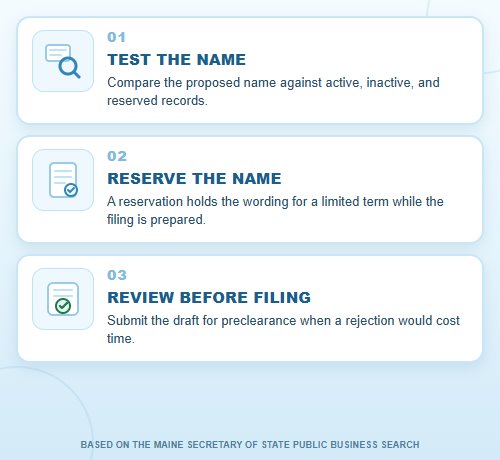
Build the name in full, with the ending required for the entity type, then compare it against the register rather than against a search engine. The test has three parts: whether an identical record exists, whether a close record exists, and whether the difference between the two would matter to a customer. Run all three before you spend money on a reservation.
Assemble the Name You Intend to File
Write the name exactly as it will appear on the certificate, including the ending and any punctuation you plan to use. Then write a stripped version with punctuation removed and the ending dropped. The stripped version is what the examiner effectively compares. If the stripped version matches a live record, the styled version will not save the filing.
Compare Against Live Records
An identical name held by a dissolved company is a different problem from an identical name held by an active one. Sort the results by status and read the formation dates. A name released years ago is usually open, while a name held by a company that is merely delinquent can still be refused because the entity has not finished dissolving. Confirm the status before you count a name as free.
Read a Refusal Before You Argue With It
A refusal letter names the conflicting record and the reason the division sees a conflict. Read the cited name, not the one you proposed, and look for the shared word the examiner relied on. If the cited record is inactive or was dissolved before your filing, the letter may rest on stale data, and a call to the division can settle it. If the shared word is the whole identity of both names, the refusal will stand.
Name reservation:
https://apps3.web.maine.gov/nei-sos-icrs/ICRS
Reservations hold a name without creating a company.
Distinguishable and Deceptively Similar
Maine uses two ideas that sit close together. A name must be distinguishable, which means the difference has to be visible in the words themselves. It must also avoid being deceptively similar, which catches a name that looks different on paper but would be heard, remembered, or abbreviated into the same thing. Both tests are applied to the same filing.
What Distinguishable Means in Practice
A single changed letter is not a distinction when the rest of the name is identical. A changed word is a distinction when the word changes the meaning, as boat repair changes boat works. An added town can be a distinction if the town is not already part of the other name. The examiner asks whether the records would sit next to each other in a list without confusion, and the answer usually follows the first distinctive word.
Word order counts for less than owners expect. Moving the distinctive word to the front does not create a new name when the same words remain, and adding a descriptive term at the end rarely helps. The comparison reads the name as a whole, so a filer who wants distance should replace a word rather than rearrange one.
What Deceptive Similarity Adds
Deceptive similarity reaches names that a reader could confuse after hearing them once. A plural, a homophone, and a dropped letter all fall inside it. So does a name that borrows a well-known local identity and adds a generic word. The test protects the public from a mistaken purchase as much as it protects the earlier owner, which is why intent does not decide the outcome. The Maine company search record is the evidence the examiner works from.
A Test Any Customer Would Pass
Ask whether a supplier could ship to the wrong address, or whether a check made out to one name could clear for the other. Ask whether a caller who heard the name once could find the other business first. If either answer is yes, the difference is too thin. Rewrite the distinctive word rather than adding another filler, because filler is what the comparison already ignores.
Reserving a Name Before You File
A reservation holds a name for a set period while the formation document is prepared. It is a placeholder, not a registration, and it is useful when a lease, a loan, or a logo decision depends on the name being free next month. The division accepts a reservation form by mail or at the counter, and the clock starts when the division accepts it.
What the Reservation Covers
The reservation applies to the applicant and blocks a competing filing for the same name during its term. It does not create an entity, an employer account, or a tax number. It also does not prevent someone from filing a different but similar name that the examiner would still find distinguishable. Read the reservation as a hold on one set of words rather than a fence around a market.
A reservation is filed on its own form, signed by the applicant, and returned with the charge. The division does not ask for a business plan or proof of intent, and it does not publish the reservation in a way that warns other filers. Someone who searches for the name during the term may see the hold, and someone who does not search will learn about it only when a filing is refused.
The 120-Day Term and What Follows It
A reservation runs for 120 days from the date it is granted. If the formation document is not filed inside that window, the hold lapses and the name returns to the pool. A second reservation is possible, but another filer can take the name in the gap, so the practical advice is to file the certificate before the term runs out rather than to renew the hold.
Transferring a Reservation
A reservation can be transferred to another party, which happens when a buyer purchases a business before the entity is organized or when an attorney files on behalf of a client. The transfer is a separate filing and carries its own charge. Keep the transfer receipt with the formation document, because the name on the certificate should trace back to the person or company that held the reservation.
Preclearance of a Proposed Filing
Preclearance is a review of a draft before it is filed. The division reads the document and answers whether it would be accepted, which lets a filer fix a name problem, an ending problem, or a defective article without paying for a rejected submission. It is a review service rather than a filing, and the document still has to be submitted afterward.
When a Review Is Worth the Charge
A borderline name is the clearest case: two distinctive words, a near match to a live record, or a name built from a surname already in the index. A second case is a document with an unusual structure, such as a conversion or a restated certificate. A third is a filing prepared under a deadline, where a rejection would cost more than the review.
Preparing the Draft for Review
Send the form that will actually be filed, not a summary of it. Fill every article, name the registered agent and office, and include the ending for the entity type. A draft with blank fields invites a comment that costs a round trip. Attach the search results you relied on when the name sits close to an existing record, and state which distinctive word you believe separates the two.
The reply comes back as an approval or a list of defects. Work through the list in order and refile once, rather than sending a series of partial corrections. A review that produces a clean document is cheaper than three rejected submissions, even though the review charge is paid up front.
What a Review Does Not Promise
The review answers the question at the moment it is given. A competing filing accepted a day later can change the answer, and a later examiner can read the same record differently. The review also does not test trademark rights or the laws of another state. Treat the answer as an opinion on the document, not a guarantee that the name will remain yours.
Rejection, Correction, and Refiling
A rejected filing is returned with a letter that states the defect. The charge is not refunded, which is why the name should be settled before the certificate is mailed. Most refusals on name grounds come from a conflict the filer could have found, and most of the rest come from a missing ending or a name that does not match the filing type.
Fixing a Name Refusal
There are three paths. Change the distinctive word and refile. Obtain written consent from the holder of the cited name and include it. Or show that the cited record is not a barrier because it has been dissolved or because the names differ in more than filler. The first path is the fastest, the second needs a cooperative holder, and the third needs evidence from the record itself.
Choose the path before you rewrite the document, because each one changes a different part of the form. A consent letter attaches to the same certificate and leaves the rest alone. A new name means new signage, a new domain, and a new reservation if the old one is still running. A dissolution argument needs the status page and the date of the closure, printed and attached.
Correcting a Filing Without a New Name
A clerical error in a filed document is fixed with a statement of correction, which leaves the name and the charter number in place. A name that was accepted but should never have been is a different matter, and the division can require a change when the conflict is clear. Keep the correspondence, because a bank or a buyer may ask why the certificate and the letter disagree.
How Long the Process Takes
Paper filings are processed in two to seven business days, and the count starts when the division receives the document rather than when it is mailed. A filing sent without the correct charge is held rather than rejected, which adds days without a letter. Send the form, the charge, and any consent in one envelope, and keep a copy of everything.
A Reserved Name Is Not a Formed Entity
Owners sometimes treat a reservation as proof that the company exists. It is not. A reserved name is a place in line, and the entity begins on the date the formation document is accepted. Until then there is no charter number, no limited liability protection, and no authority to sign in the company name.
What Still Has to Be Filed
An LLC files a certificate of formation, a corporation files articles of incorporation, and a nonprofit files its own articles with the required purpose language. Each document names the registered agent and the registered office, and each produces a charter number. The reservation is not attached to the certificate as a matter of course, so mention the reservation on the cover letter if the name depends on it. The Maine name records page covers how the resulting record is read.
What the Hold Does Not Protect
A reservation does not shield personal assets, does not create a tax identity, and does not license the business in any town. It also does not stop a different company from using the same words in another state. An owner who signs a lease before formation is personally liable on that lease, and a reservation changes nothing about that outcome.
The order that avoids trouble is short. Reserve the name, open the bank account only after the certificate is accepted, and sign nothing in the company name until the charter number exists. If a landlord insists on a signature before formation, sign personally and plan to assign the lease once the entity is registered.
State Clearance and Trademark Collision
Maine clears names against its own register. It does not clear them against the federal trademark register, and it does not search unregistered use in the marketplace. A name can be perfectly available in Augusta and still belong to someone else in commerce, which is the gap that catches businesses after they print signage and open a bank account.
Two Registers, Two Questions
The state asks whether the name is distinguishable from other registered entities in Maine. A trademark search asks whether a mark is likely to confuse buyers about the source of goods or services. The second question can be answered yes even when the first is answered no, especially when the earlier mark is registered for a related product. A federal search costs nothing to run at the basic level and takes minutes.
Search the name as a word, then search it with the product category beside it. A mark registered for clothing can block a clothing brand while leaving a landscaping company free to use the same words. Note the class and the goods listed, because a live registration in an unrelated class is a weaker obstacle than an abandoned one in your own field.
Rights That Come From Use
A business that sells under a name for years can build protectable rights without any registration, and those rights can be asserted against a later user in the same territory. A state filing does not defeat them. A new owner who plans to advertise, franchise, or sell online should treat the trademark question as a separate project rather than a box checked at formation.
Keep evidence of first use: invoices, dated photographs, advertising, and the first sale tied to the name. A file of that kind settles priority questions that no register can answer, and it takes minutes a year to maintain.
A Sensible Order of Work
Search the state register, search the federal register, and search the open web for the name in the trade. Read the results together before deciding. When the name survives all three, reserve it and file the formation document. When it fails at the federal level, change the name now, because a rebrand after a demand letter costs far more than a second reservation.
When the Name Must Change After Formation
A company that loses a name dispute or chooses a new identity files an amendment and receives a new certificate under the same charter number. The entity continues without a break, and the filing history shows both names. The work that follows is administrative, but it reaches every account the business holds.
The Amendment and the Records
The amendment states the old name and the new one, and the charter number ties the two records together. Order a certified copy after acceptance, because a bank will want the document rather than a screenshot. Update the annual report at the next cycle, and check that the registered agent and office still read correctly.
Accounts That Must Match
The tax account, the payroll account, the insurance policy, the lease, and every license should carry the new name. A check deposited under the old name can be returned even when the account number is correct. A name change also affects any assumed name built on the old words, which may need to be terminated or replaced.
Charges for Reservation and Review
Each charge below is set by statute and applies to the service named in its row. A refused submission still consumes the payment, so settle the name before the form goes out.
| Filing | Fee | Notes |
|---|---|---|
| Name reservation, business entity | $20.00 | Held for 120 days |
| Transfer of reservation | $20.00 | To another applicant |
| Name reservation, nonprofit corporation | $5.00 | Same 120-day term |
| Preclearance of a filing | $100.00 | Review before submission |
Frequently Asked Questions
These questions come from owners who have a name in mind and want to know whether the state will take it.
How long does a Maine name reservation last?
One hundred twenty days from the date the division grants it. If the formation document is not accepted inside that window, the name returns to the pool and another filer can claim it.
Can I reserve a name and never form the company?
Yes, but the hold is temporary and it creates nothing. No entity, no charter number, and no liability protection exist until the formation document is accepted.
Does a reservation guarantee the name will be accepted?
No. The reservation holds the words against competing filings, and it does not settle every comparison question. A later document can still be refused if the examiner finds a conflict the reservation did not address.
Is a nonprofit reservation cheaper?
Yes. A nonprofit corporation pays a reduced rate for the same 120-day term, and the transfer charge stays the same as for a business entity.
What happens if my name filing is refused?
The document comes back with a letter naming the conflict. Change the distinctive word, file written consent from the holder, or show that the cited record is no longer a barrier, then submit again with a new charge.