A Maine business name search answers a narrow question: whether a name already sits on the state register, and which entity holds it. The Division of Corporations, UCC and Commissions keeps domestic and foreign filings in one index, so a limited liability company, a business corporation, a nonprofit, and a limited partnership all appear in the same result list. The lookup costs nothing and needs no account.
The difficulty is in reading what comes back. A name that looks free can be blocked by a record that differs only in punctuation, and a name that looks taken can belong to a dissolved company that stopped filing years ago. What follows covers legal names, trade names, entity endings, former names, and the comparison the division applies. The name filing charges are listed below.
How to Search Maine Business Name Records
The ICRS portal opens on one text field with a filing type filter beside it. Type the name the way the owner writes it, run the search, then repeat with the ending removed if the first pass comes back empty. An empty result is a fact worth having, but it is only reliable after the second attempt.
Start With the Full Legal Name
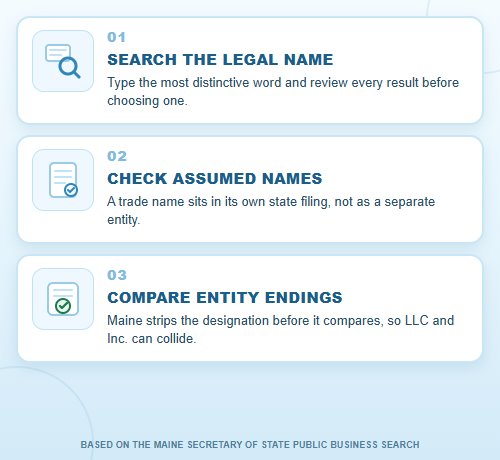
Enter the whole name including the ending, because the index stores what was filed. Apostrophes and quotation marks do not need to be reproduced exactly, and a stray space rarely matters. Spelling does matter, since the index is a text match and not a phonetic one. Try the two most likely spellings before concluding that a name is absent.
Read the Result Columns Before Opening a Record
Each row shows the name, the charter number, the filing type, a status, and often a town. Read the filing type first, because a corporation and a limited liability company can carry near-identical names and only one of them answers your purpose. Status comes second. An inactive row means the name may be reusable, which the availability rules treat in detail.
A long list rewards sorting. Put the active records at the top and the older filings at the bottom, then look for a town that matches the address you were given. The town field is not the principal office, so treat it as a hint rather than proof. Open two or three rows before deciding, because the first row is often an unrelated company that simply registered first.
Search a Single Company by Charter Number
When the number is already in hand from a contract or an annual report, use it instead of the name. A charter number survives a name change, so it is the one field that still points at the same company after the name has moved. Enter it without spaces, dashes, or a leading zero that the record does not display.
Name directory:
https://apps3.web.maine.gov/nei-sos-icrs/ICRS
Searches include active and closed records alike.
Legal Name and Trade Name Are Different Entries
Maine registers two kinds of name, and they carry different weight. The legal name is the one on the formation document and belongs to the entity. A trade name is a label the entity uses in public, and it sits in a separate filing tied to the owner’s charter number. Mixing the two produces searches that miss the record you actually need.
What the Legal Name Establishes
The legal name signs contracts, holds licenses, and appears on the annual report. It must carry a required ending and must be distinguishable from names already registered. Changing it takes an amendment and a new certificate, and the charter number stays the same. A bank statement, a deed, and a lawsuit caption should all use this name.
Two state records can share a mailing address and still be separate businesses. A registered agent handles mail for hundreds of entities, so an address match proves almost nothing on its own. When the name and the address both line up, confirm the charter number, then read the filing history for a merger or a conversion that moved the business into a new record.
Where an Assumed Name Is Recorded
An assumed name statement goes to the same division but is stored as its own record. The filing identifies the entity, its state number, and the trade wording, and it creates no new entity. Someone who searches only the label may find it without realizing that a different legal name stands behind it. The Maine company search page shows how both kinds of record surface in one result list.
Why the Difference Matters to a Lender
Paperwork at a bank names a borrower, and the borrower has to be the legal entity. A signature line with a trade name and no statement on record is a file an underwriter will send back. Bring the formation document, the assumed name filing, and the annual report that confirms the agent, and account opening stops being an argument about names.
Entity Endings and How the Index Stores Them
Every registered entity carries an ending, and the ending is part of the name rather than a decoration. The index stores the ending as filed, which means one company may appear with periods and another without. That inconsistency is expected, and it is the reason a search should treat the ending as optional on a first pass.
Required Endings by Filing Type
A limited liability company ends in Limited Liability Company, L.L.C., or LLC. A business corporation ends in Incorporated, Inc., Corporation, or Corp. A nonprofit corporation uses Corporation or Incorporated without a profit word, and a limited partnership uses Limited Partnership, L.P., or LP. A limited liability partnership adds LLP or Registered Limited Liability Partnership. A filing that lacks the ending for its type will not be accepted.
Punctuation, Case, and Spacing
The division does not treat a period, a comma, an ampersand, or a hyphen as meaningful when it compares names. Case is ignored and extra spaces collapse. A name written as Kennebec Home Goods, L.L.C. occupies the same ground as KENNEBEC HOME GOODS LLC. An owner can style the name on signage, but the filed version should follow the form and stay consistent across every document.
When a Similar Name Is Allowed by Consent
A filer who wants a name close to an existing one can sometimes obtain written consent from the holder and file it with the application. The consent does not rewrite the comparison rule; it answers the objection that the holder would otherwise raise. Consent appears between a parent and a subsidiary, or after a sale of assets that includes the name.
Keep the consent letter with the filing receipt. The division may accept the document once, and a later examiner may still question a second company built on the same words. A consent covers the filing in front of it rather than a family of future names.
How Maine Compares Two Names
The comparison is not a spell check and not a keyword match. The division removes punctuation and entity endings, then asks whether what remains would lead a reasonable person to confuse the two businesses. That test is why a small change in wording does not buy a new name.
Distinguishable Rather Than Different
Two names are distinguishable when the differences carry meaning. Portland Boat Works LLC and Portland Boat Repair LLC share a town and an industry but describe different trades, so both can stand. Portland Boat Works LLC and Portland Boatworks LLC differ only in spacing, and the second will not pass. The question is whether a customer, a vendor, or a check writer could mix them up.
Industry words carry little weight when they describe the business itself. A company selling outdoor gear gains nothing from the word outdoors, because the word tells a reader what the shop does rather than who it is. A surname, an invented word, or a place name tied to a specific landmark does more work. Build the proposed name around the word a customer would use to recommend the business.
Words the Comparison Sets Aside
Entity endings go first. The words the, of, and, company, and co carry little weight alone, so The Katahdin Company and Katahdin Co. sit close together. Two names built from the same distinctive word plus one of those fillers are treated as one name for filing purposes. A genuinely new distinctive word is what separates them.
Articles, Plurals, and Sound
A leading article rarely rescues a name, and a plural ending rarely does either, so Saco River Candle and Saco River Candles are near neighbors. Sound matters as well, because a name spelled differently but spoken the same can still be refused as deceptively similar. A proposed name that depends on a letter swap should be tested against the Maine name availability rules before any form is mailed.
Geographic Words and Their Limits
A town name can anchor a business, and it can also crowd one. Portland, Bangor, and Augusta appear on hundreds of records, so a name built only from a city plus an industry word sits in a dense field. The same logic applies to a county name or a river. A geographic word works best when it pairs with a surname or an invented term, so that the whole name points at one shop.
Maine does not treat a town as a protected territory. A business in one county can hold a name that a business in another county wanted, and the state comparison does not weigh distance. A local owner who cares about a town should check the town clerk record as well as the state index.
Former Names and Names That Return
A company can change its name and leave the old one behind, and the old name can later belong to someone else. The index keeps the amendment in the filing history but does not hold the abandoned name in reserve. A search on a former name may return the company that gave it up, the company that later took it, or nothing at all.
Tracing a Name Through Amendments
An amendment record shows the old name and the new name together, and the charter number ties them. Read the history from the formation date forward when the current name does not appear. A company that has changed names twice can be found under words no one at the business still uses, which is why the number is the sturdier lookup.
A Dissolved Name Coming Back
A name held by a dissolved company can become available once the entity is gone, and the division may accept it for a new filing. The new owner inherits the words but not the history. A vendor who searches the name alone may read an old judgment or an old news item and attribute it to the wrong business, so match the formation date before drawing a conclusion.
Assumed Names in the State Register
An assumed name filed with the division appears as its own entry rather than as a field on the entity record. The entry lists the assumed name, the owner, the charter number, and the filing date. Searching the label alone can return the entry without the underlying company, which is why the owner line deserves as much attention as the name.
Pairing an Assumed Name With Its Charter
Open the owner line, note the charter number, and run a second search on that number. The second search returns the legal entity, its status, its agent, and its report history. Two records read together show who stands behind the label. One record read alone shows only that somebody registered the words.
Some entries name the owner as an individual because the filing predates a change of form. A sole proprietor who later organized an LLC may keep an old assumed name tied to the person rather than to the new company. Read the filing date before you assume that the current entity owns the label.
When the Owner Line Does Not Match
An assumed name can outlive a sale of the business, and the owner on file may not be the person running the counter. A mismatch is not fraud by itself, but it is a reason to ask for the purchase agreement or the assignment. Confirm the current owner before paying an invoice made out to the label rather than to the entity.
Names Held by Town Clerks
Not every Maine business name lives in the state index. A sole proprietor and a general partnership register a trade name with the clerk in the town where the business operates, and the division has no record of it. A statewide search that returns nothing may still be missing a name on file at city hall.
Sole Proprietors and General Partnerships
These two forms file no formation document with the state, so there is no charter number and no annual report. The owner registers the trade name locally, pays a clerk fee, and renews or updates it under town rules. A bank, a landlord, and a customer can all deal with such a business without the state ever seeing its name.
What the Town Record Contains
A town filing usually lists the owner, the business name, the address, and a filing date, and the format varies by municipality. Some clerks keep a bound ledger, some keep a database, and some answer by phone only. Call the clerk in the town where the shop sits, give the exact name, and ask whether an owner is on file. Records for a closed business may be archived rather than searchable.
Search Habits That Find the Real Match
A search is a short experiment, and the order of attempts decides whether it succeeds. The habits below apply to any name in the index, whether the target is a limited liability company, a corporation, or a partnership.
Lead With the Distinctive Word
Skip the town, the industry, and the ending on the first attempt. The word that makes the name unique is the word to type. Katahdin narrows a list fast; Maine returns hundreds of rows. When the distinctive word appears in many names across the trade, add the second word rather than the location.
A misspelled distinctive word produces a blank page, and a blank page is easy to misread as an available name. Sound the word out and try the phonetic spelling as well. Owners of small businesses often file a spelling that differs from the one on the sign, and the index keeps the filed version only.
Set the Ending Aside on the First Pass
Because the index stores endings inconsistently, a search that includes the ending can hide a match filed as L.L.C. or Limited Liability Company. Run the stem first, then narrow. The same habit applies to Inc. and Corp., which appear with and without periods across filings that are otherwise identical.
Compare Numbers Instead of Names
Two rows with similar names are not necessarily related, and two rows with different names can share an owner. The charter number is the identifier that settles identity. Write it down, compare it with the number on the document in hand, and treat a match on the number as a match on the company.
What a Name Search Cannot Settle
The register confirms that a name is filed and shows who filed it. It does not grant rights to the name, and it does not stop another business from using something similar in another state. A state record is evidence of registration, not evidence of ownership in the trademark sense.
The file also says nothing about licenses, insurance, tax standing, or debts. A name that is clear at the division can be tied to a franchise agreement, a consent order, or a pending lawsuit that never reaches the index. Treat the result as one fact among several, and date the copy you keep.
A name search is also not a clearance opinion. It reports what Maine has registered, and it says nothing about unregistered use in another state or a federal registration that covers the same words. A business that plans to sell beyond New England should look at the federal register as well, and a lawyer can weigh the risk that a search cannot see.
Filing Charges for Name Records
These are the statutory charges that attach to the name filings covered here. Each one is printed on the division’s own form, and no figure changes with the size of the business.
| Filing | Fee | Notes |
|---|---|---|
| Name reservation, business entity | $20.00 | Optional hold |
| Assumed name statement | $125.00 | Entity filing |
| Termination of assumed name | $20.00 | Ends the statement |
Frequently Asked Questions
These questions come from owners checking a name before filing and from buyers checking a name before signing.
Does a Maine name search cost anything?
No. The corporate search is free and open to anyone with a browser. Charges begin with filings such as a reservation or an assumed name statement, and copies and certificates are ordered separately.
Can I use a name that belonged to a dissolved company?
Often yes, once the old entity is no longer registered. The division still tests the name for confusion with active records, so confirm the current status and check for a successor that adopted the same words.
Is an assumed name the same as a legal name?
No. An assumed name is a label registered to an owner, and it does not create an entity, a charter number, or limited liability. The legal name remains the one on the formation document.
Why does a name with different punctuation still count as a match?
Maine strips punctuation and entity endings before it compares. A period, a hyphen, or a comma does not create a new name, and neither does a change in capital letters.
Where do I look for a sole proprietor’s business name?
At the town clerk in the municipality where the business operates. The Secretary of State does not hold trade names for sole proprietors or general partnerships.